What is Kari’s Law? 911 Rules for Business Phones (2026)
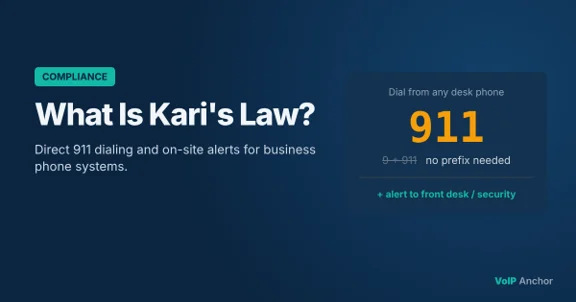
Kari’s Law means anyone can dial 911 from a business phone without pressing 9 first. Here’s the story behind it, what it requires, and how to make sure your phone system complies.

VoIP Anchor is independent. No provider pays to be featured or reviewed. Our disclosure
On this page
In an emergency, anyone should be able to pick up a phone and dial 911. For years, that wasn’t true in many hotels, offices and campuses, where phone systems required you to dial 9 first to get an outside line. Kari’s Law changed that.
If your business runs a multi-line phone system, including a cloud VoIP system, Kari’s Law applies to you. This guide explains where the law came from, what it requires, and how to make sure your phones comply.
The story behind Kari’s Law
On December 1, 2013, Kari Hunt was attacked by her estranged husband in a motel room in Texas. Her young daughter tried to call 911 four times, but the calls never connected. The motel’s phone system required guests to dial 9 before any outside number, including 911.
Kari Hunt died from her injuries. Her family began campaigning so that no one else would face the same barrier. Their efforts led to state laws and, eventually, a federal law.
The Kari’s Law Act of 2017 was signed into law on February 16, 2018. The FCC adopted rules to put it into practice in 2019, and the requirements took effect on February 16, 2020.
What Kari’s Law requires
Kari’s Law applies to multi-line telephone systems (MLTS): phone systems that serve many users through shared lines, as in offices, hotels, schools, hospitals and campuses. That includes on-premises PBXs and cloud-based VoIP phone systems.
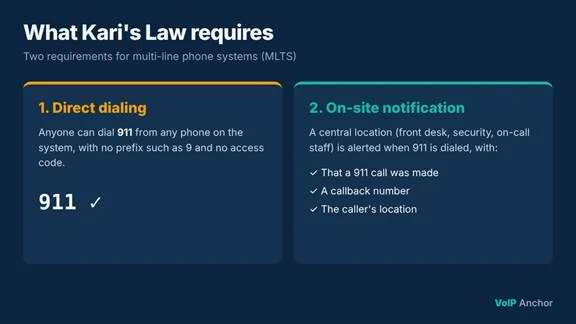
It has two core requirements.
1. Direct dialing to 911
Users must be able to dial 911 directly from any phone on the system, without first dialing a prefix such as 9 or any other access code. If your system normally uses 9 for an outside line, it must also recognise 911 on its own.
2. On-site notification
When someone dials 911, the system must notify a central location, such as a front desk, security office or on-call staff, on-site or off-site. The notification must include:
- The fact that a 911 call was made
- A valid callback number
- The caller’s location information, where technically feasible
This helps staff respond quickly: meeting first responders at the entrance, unlocking doors and guiding them to the right floor or room.
The notification must not delay the 911 call itself; the call goes through to emergency services immediately.
Who must comply with Kari’s Law
The responsibility is shared across everyone involved with the phone system:
- Manufacturers, importers, sellers and lessors of MLTS must ship systems pre-configured for direct 911 dialing.
- Installers must set systems up so direct 911 dialing works.
- Managers and operators, often the business itself, must keep the system configured correctly and set up notifications.
Key dates
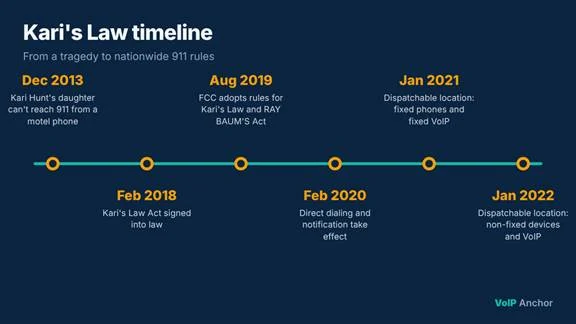
| Date | What happened |
| December 1, 2013 | Kari Hunt is killed; her daughter can’t reach 911 from the motel phone |
| February 16, 2018 | Kari’s Law Act of 2017 signed into law |
| August 1, 2019 | FCC adopts rules for Kari’s Law and RAY BAUM’S Act |
| February 16, 2020 | Direct dialing and notification required for systems made, sold, leased or installed after this date |
| January 6, 2021 | Dispatchable location required for fixed MLTS phones and fixed VoIP |
| January 6, 2022 | Dispatchable location required for non-fixed devices and non-fixed VoIP, where technically feasible |
Systems manufactured, sold, leased or installed on or before February 16, 2020 aren’t covered by the direct dialing requirement. That said, updating older systems is still good practice, and it costs little on most modern platforms.
Kari’s Law and RAY BAUM’S Act
Kari’s Law is often mentioned alongside Section 506 of RAY BAUM’S Act. Kari’s Law makes sure a 911 call connects. RAY BAUM’S Act makes sure responders know exactly where the caller is.
It requires a dispatchable location to be sent with 911 calls: a street address plus details such as the floor, suite or room number. For VoIP users who move between locations, providers must offer ways to keep that location up to date.
Penalties
The FCC enforces Kari’s Law and can fine businesses and vendors that don’t comply. Fines can reach thousands of dollars, with additional daily penalties for continuing violations.
Kari’s Law compliance checklist for businesses
Whether you use an on-premises PBX or a cloud VoIP system, run through these checks:
- Test direct 911 dialing. Confirm that dialing 911 works from every phone without a prefix. Coordinate with your provider and local emergency centre before placing a live test call, or use your provider’s test procedure.
- Keep 9-911 working too. People in an emergency may still dial 9 first out of habit, so make sure 9-911 also connects.
- Set up notifications. Choose who gets alerted (front desk, security, office manager) and how: on-screen alert, email, text or a call.
- Register dispatchable locations. Add the street address plus floor, suite or room for every phone or user.
- Plan for remote and hybrid staff. Make sure softphones and mobile apps can update their location when people work from home or travel.
- Ask your VoIP provider for written confirmation that their system supports Kari’s Law and RAY BAUM’S Act requirements.
- Review after every change. Office moves, new phones or new remote workers all mean updating locations and notifications.
- Train your staff. Make sure the people receiving notifications know what to do when an alert comes in.
Frequently asked questions
What is Kari’s Law in simple terms?
Kari’s Law is a US federal law requiring business phone systems to let anyone dial 911 directly, without a prefix like 9, and to alert someone on-site when a 911 call is made.
Does Kari’s Law apply to VoIP phone systems?
Yes. It applies to multi-line telephone systems, which include cloud VoIP systems used by businesses, hotels, schools and other organisations.
When did Kari’s Law take effect?
The law was signed on February 16, 2018, and its requirements took effect on February 16, 2020, for systems made, sold, leased or installed after that date.
Does Kari’s Law apply to small businesses?
Yes, if the business uses a multi-line phone system. Size doesn’t create an exemption. A single home phone line isn’t covered.
What is the difference between Kari’s Law and RAY BAUM’S Act?
Kari’s Law ensures 911 calls connect directly and on-site staff are notified. RAY BAUM’S Act requires an accurate dispatchable location, such as the address and room, to be sent with the call.
Final thoughts
Kari’s Law exists because a phone system setting stood between a child and help. Today, making sure every phone in your business can dial 911 directly and alert the right people is both a legal requirement and simple common sense. Check your system, register accurate locations, test with your provider and make it part of your routine whenever your office or team changes.