
Copper Landline Retirement: What it Means for you in 2026
US carriers are switching off the copper phone network. Here’s what copper landline retirement means for homes and businesses, the latest FCC rules, and how to move your lines without disruption.

VoIP Anchor is independent. No provider pays to be featured or reviewed. Our disclosure
On this page
For more than a century, the phone on the wall ran over a pair of copper wires. That network is now being switched off. Carriers across the US are moving customers to fiber, wireless and internet-based phone service, and the FCC has made it easier for them to do it faster.
Copper landline retirement affects far more than home phones. Alarm panels, fax machines, elevator emergency phones and card terminals often still depend on those same copper lines. If you’re a homeowner, a small business or a facilities manager, this guide explains what’s changing, when, and how to prepare without losing service.
What is copper landline retirement?
Copper landline retirement is the process of shutting down the traditional copper telephone network, sometimes called POTS (plain old telephone service) or the PSTN, and replacing it with newer technology. The industry also calls it the “copper sunset”.
In practice, it happens in two ways:
- Network retirement: the carrier removes or stops maintaining copper cables in an area, usually after building fiber.
- Service discontinuance: the carrier stops offering traditional landline service over copper and moves customers to a replacement, such as fiber-based voice, fixed wireless or VoIP.
Your phone number doesn’t have to change. What changes is the technology carrying your calls.
Why carriers are retiring copper
Copper landline retirement comes down to two things: copper is expensive to keep running, and very few people still use it.
- High maintenance costs. AT&T has said it spends about $6 billion a year maintaining its copper network.
- Shrinking demand. By AT&T’s own figures, only about 5% of its customers still use copper-based voice service.
- Ageing infrastructure. Much of the copper network is decades old. It’s vulnerable to water damage, storms and cable theft, and spare parts and skilled technicians are harder to find.
- Better alternatives. Fiber, 5G and fixed wireless carry voice and fast internet at the same time, and they’re cheaper to operate.
In December 2024, AT&T announced it plans to essentially retire its copper network by 2029, moving customers to fiber or fixed wireless. In areas where it won’t build fiber, which cover roughly half its landline footprint but only about 10% of customers, its goal is to have no customers on copper by 2027. Other incumbent carriers, including Verizon, are also moving customers off copper in parts of their networks.
Copper landline retirement rules: what the FCC changed
Carriers can’t simply cut off copper overnight. They need FCC approval to discontinue service, and they must give notice of network changes. Over 2025 and 2026, the FCC significantly loosened those rules, most recently in its March 2026 order published in the Federal Register.
Key dates
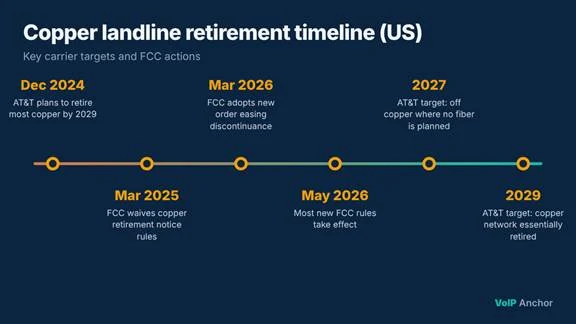
- December 2024: AT&T announces plans to retire most of its copper network by 2029.
- March 2025: The FCC issues four orders that waive, for at least two years, the requirement to file advance notice of copper retirements, and relax how carriers prove a replacement service exists.
- March 26, 2026: The FCC adopts a new order, Reducing Barriers to Network Improvements and Service Changes, making many of those changes permanent.
- May 20, 2026: Most of the new rules take effect. A few provisions are delayed until the FCC announces their start date.
- 2027: AT&T’s target for moving all customers off copper in areas where it won’t build fiber.
- 2029: AT&T’s target for retiring essentially all of its copper network.
What the 2026 FCC order means for customers
- Faster approvals. Requests to discontinue service are automatically granted after 31 days unless the FCC acts.
- One replacement test. A carrier qualifies for fast-track approval if a qualifying replacement is available across the area. That includes interconnected VoIP, mobile service of at least 5/1 Mbps, or the carrier’s own voice service with 911 access.
- Bundles count. The replacement doesn’t have to be a stand-alone phone line. A bundle that includes voice qualifies, but carriers must disclose price differences.
- Less public filing. Carriers no longer file copper retirement notices with the FCC, but they must still post public notice and directly notify 911 providers and connected carriers.
- Grandfathering. Carriers can stop selling legacy copper services to new customers, after notifying existing customers with a “no earlier than” date and alternatives.
State rules still matter. Some states have relaxed “carrier of last resort” obligations, while others, such as California, have kept stronger protections.
The US isn’t alone. The UK, for example, is switching off its copper-based PSTN, and many other countries are on similar paths.
Who is affected by copper landline retirement?
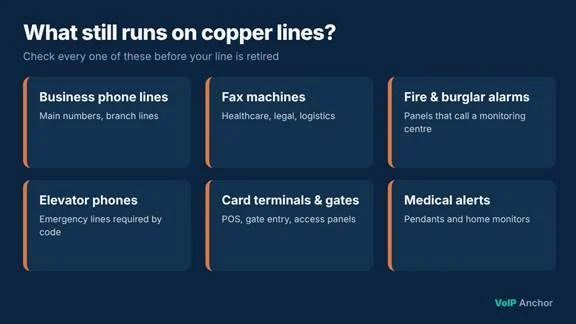
If you still pay for a traditional landline, you’ll eventually be moved, whether you use it for calls or not. The people who need to plan most carefully are those with devices connected to copper lines, not just phones.
Homes
- Home phones, especially for older relatives who rely on a landline.
- Medical alert pendants and monitoring devices that dial out over the phone line.
- Home security systems that report alarms over a landline.
Businesses and buildings
- Main business lines and fax machines, still common in healthcare, legal and logistics.
- Fire and burglar alarm panels that call a monitoring centre.
- Elevator emergency phones, which building codes require to work.
- Card payment terminals, gate entry systems and building access panels.
- Multi-location businesses with dozens of forgotten lines across branches, ATMs or kiosks.
Rural customers
Rural areas are often where copper is retired first, and where fiber may not arrive. Replacements there are more likely to be fixed wireless, mobile or satellite-based, so check coverage and call quality carefully.
One key difference: traditional copper lines carry their own power, so they can work during a power cut. Most replacements (VoIP, fiber, wireless) need electricity, so plan for battery backup for anything safety-related.
Your replacement options
There’s no single right replacement after copper landline retirement. It depends on what the line is used for.
| Option | How it works | Best for | Watch out for |
| VoIP phone service | Calls run over your internet connection, through desk phones, apps or an adapter | Businesses, remote teams, most home users | Needs internet and power; check 911 address setup |
| Carrier’s own replacement | The carrier moves your line to fiber or wireless and keeps your existing phone working | People who want minimal change | Pricing and features vary by carrier and area |
| Cellular landline adapter | A small box connects your existing phone to the mobile network | Homes and sites without reliable internet | Depends on mobile signal strength |
| Dedicated POTS replacement device | A cellular or IP unit built for alarms, elevators and fax | Fire alarms, elevators, gates, card terminals | Must be certified for the device it serves |
| Mobile only | Drop the landline and use mobile phones | Individuals and very small businesses | Not suitable for alarms or elevators |
Why VoIP is often the best fit
For most businesses and many homes, VoIP is the most flexible replacement for copper landline retirement:
- Keep your number. You can port your existing landline number to a VoIP provider.
- More features. Call forwarding, voicemail-to-email, multiple lines and mobile apps come standard.
- Lower costs. VoIP is often cheaper than a traditional business line, especially for multiple lines.
- Works anywhere. Your number rings on your desk phone, laptop or mobile.
For safety systems such as fire alarms and elevator phones, use a device certified for that purpose rather than a general VoIP line.
How to prepare for copper landline retirement
Don’t wait for a discontinuance notice. Moving on your own schedule is cheaper and far less stressful.
- Audit every line. List each copper line on your bills, with its number, location and what it’s connected to. Businesses are often surprised by forgotten lines for alarms, faxes or old branches.
- Read carrier notices carefully. Look for a “no earlier than” date and the replacement the carrier is offering.
- Separate voice lines from device lines. Phones and fax can usually move to VoIP. Alarms, elevators and medical devices need certified replacements.
- Talk to your alarm and elevator vendors. Ask whether your equipment works with cellular or IP communicators, and what the code requirements are where you are.
- Choose replacements and compare costs. Get quotes for VoIP, carrier options and POTS replacement devices.
- Port your numbers. Keep your existing numbers by porting them to the new service, and keep the old line active until the port completes.
- Plan for power cuts. Add battery backup (UPS) for modems, routers and safety devices, and check your provider’s backup options.
- Update 911 details. For VoIP, register the correct physical address for every line so emergency services can find you.
- Test everything. Make test calls, send a test fax and run an alarm test with your monitoring centre before cancelling copper.
Frequently asked questions
When will copper landlines be retired?
It varies by carrier and area. AT&T aims to retire essentially all of its copper network by 2029, with areas that won’t get fiber moved off copper by 2027. Other carriers are retiring copper area by area.
Will I lose my phone number when copper is retired?
No. You can keep your number by moving to the carrier’s replacement service or porting it to another provider, such as a VoIP service.
Can my carrier shut off my landline without notice?
No. Carriers must notify customers before discontinuing or grandfathering service, including a date and the alternatives available. The FCC’s 2026 rules shortened approval times, so act on notices quickly.
Will my alarm system or fax machine still work?
Not automatically. Many alarm panels and fax machines need a certified cellular or IP replacement device. Check with your alarm company or equipment vendor before the switch.
Does VoIP work during a power outage?
Only with backup power. Add a battery backup for your modem, router and phones, or use a mobile app on your phone as a fallback.
Final thoughts
Copper landline retirement is no longer a distant plan. With carriers setting firm targets and the FCC speeding up approvals, most copper lines in the US will be switched off within the next few years. The good news is that the replacements, especially VoIP, usually offer more features at a lower cost.
Start with an audit of your lines, deal with alarms and other devices first, and move your numbers before you’re forced to.

One Comment