Landline Phase Out: What It Means for Your Business Phone
Phone companies are retiring copper landlines faster after a March 2026 FCC order. Here’s what that means for your business lines, alarms and 911, and how to switch without surprises.

VoIP Anchor is independent. No provider pays to be featured or reviewed. Our disclosure
On this page
- What is the landline phase out?
- How the landline phase out works
- Why the landline phase out matters for your business
- The lines most at risk
- How to prepare for the landline phase out, step by step
- Pick a replacement for each line
- Landline phase out rules and notice periods
- Common mistakes to avoid
- Frequently asked questions
- Sources
Key takeaways
- The landline phase out is the planned shutdown of copper phone lines, sped up by an FCC order on March 26, 2026.
- AT&T is aiming to shut down most of its copper by the end of 2029.
- The 90-day rule covers other carriers. The FCC says customers get direct notice 30 days before service is discontinued.
- Fire alarms, elevator phones and card terminals often run on copper too, and each needs its own plan.
- Run the five-step LINES check now, before a notice arrives.
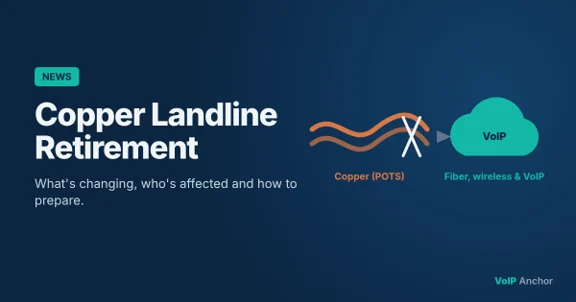
The landline phase out is the planned shutdown of copper phone lines, often called POTS (plain old telephone service). A March 2026 FCC order sped it up, and your notice may be only 30 days.
This guide is for small-business owners and office managers who still pay for a landline. It explains how the phase out works, which equipment is at risk, and the notice rules. It ends with a five-step plan to switch without losing your number or your alarm monitoring.
This is general information, not legal advice.
What is the landline phase out?
The landline phase out is the move by US phone companies to retire their copper networks and the landline service that runs on them. A traditional landline uses a pair of copper wires from the local exchange to your building. Carriers want to replace that copper with fiber, wireless and internet-based (IP) service, because copper is costly to maintain.
The FCC says its 2026 rules will free up tens of billions of dollars a year for newer networks. The shift is already large. The US once had about 130 million POTS lines and now has about 15 million, MetTel’s COO told Fierce Network in October 2026.
Picture a five-person dental office with two phone lines, a fax line and an alarm panel that dials out over copper. When the carrier retires copper in that area, all four lines need a new home. The phones are the easy part. To see how internet calling replaces them, read our guide to VoIP explained.
How the landline phase out works
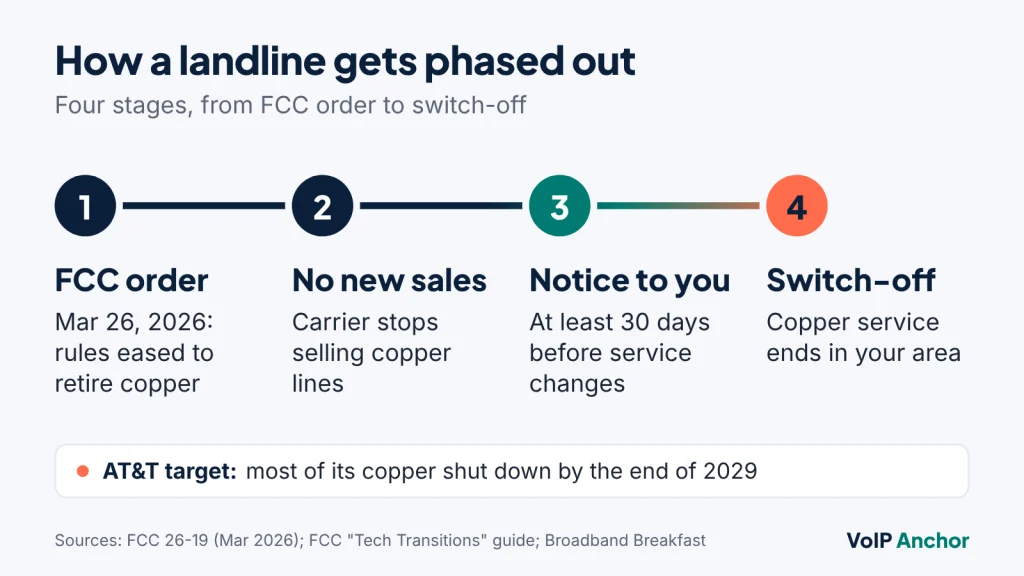
The landline phase out happens in four stages. You only get a say once the third stage starts, so it pays to prepare early.
- The FCC eases the rules. On March 26, 2026, the FCC adopted its Network and Services Modernization Order (FCC 26-19). It removed filing steps and said state rules that keep old networks running after FCC approval are overridden by federal law.
- Carriers stop new sales. The order lets carriers “grandfather” copper voice, low-speed data and copper-based VoIP. That means no new customers, while existing customers usually keep service for now.
- You get notice. Carriers must notify customers directly 30 days before they discontinue, reduce or impair a service, according to the FCC’s consumer guide. You then have 15 days to file comments or objections.
- Copper is switched off. Once approved, the carrier ends copper service in your area. AT&T is aiming to shut down most of its copper by the end of 2029.
Not everyone thinks the order protects customers enough. Harold Feld, senior vice president at Public Knowledge, said “Today’s Order puts people at risk,” and warned that rural customers could pay more or lose service. AT&T praised the order as a boost for investment in modern networks.
Commissioner Anna Gomez secured one safeguard: a public FCC docket for complaints about how carriers discontinue service. Carriers must mention that docket in their notices, Broadband Breakfast reported.
Why the landline phase out matters for your business
The landline phase out affects any business that still pays for a copper line, and carriers are moving quickly. The table below pulls figures from several sources into one view. It is VoIP Anchor’s analysis of the cited sources, not new research.
| Figure | What it tells you | Source |
| About 130 million → about 15 million | US POTS lines at their peak versus today | Fierce Network, Oct 2026, citing MetTel’s COO |
| About 8.5 million | Remaining business and government lines (about 6.5 million are consumer lines) | Same as above |
| 85% and 30% | Share of AT&T’s 5,000+ wire centers where it could stop new sales (85%) or start full shutdown (30%) | Broadband Breakfast, Mar 2026 |
| End of 2029 | AT&T’s target for shutting down most of its copper | Broadband Breakfast, Mar 2026 |
| About 212,500 a month | Business lines to move if 8.5 million go in 40 months | VoIP Anchor calculation from MetTel’s figures |
A “wire center” is the local building where your copper line joins the phone network. MetTel sells replacement equipment, and its COO’s 40-month estimate is a forecast, not a rule. Even so, the pace suggests installers will be busy, so book early.
The lines most at risk
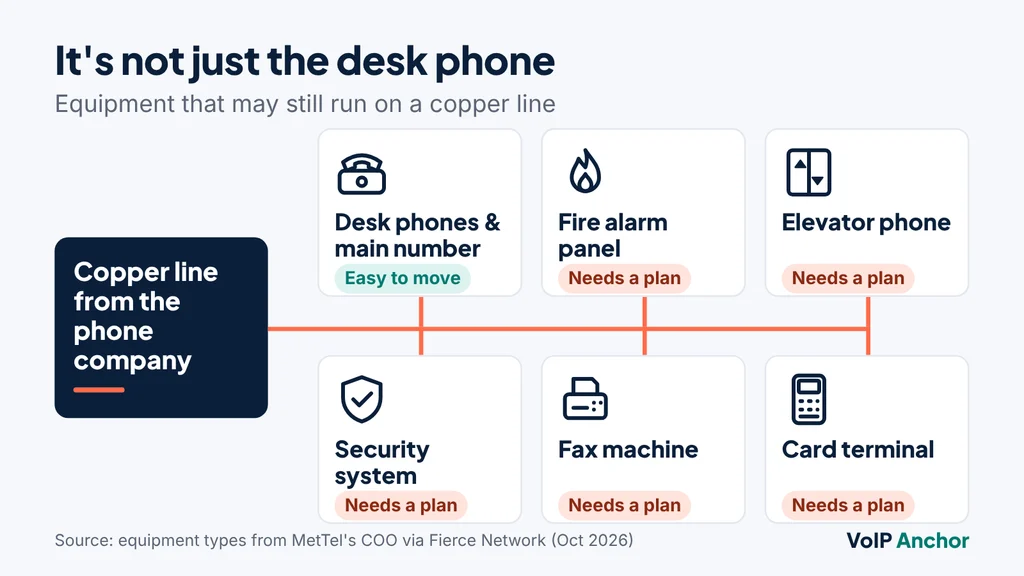
Your desk phones are the easy part. The harder lines are the ones nobody thinks about, such as fire alarms, elevators and security systems.
Power is the second risk. Copper lines carry their own power, so a corded phone usually works in a blackout. Fiber, cable and wireless service usually need a battery or other backup, and the FCC warns that VoIP may not work during a power cut or internet outage.
| Line type | Why it matters | Ask your provider or vendor |
| Fire alarm panel | Monitoring may stop if the line goes dead | Is the replacement approved by our alarm company and local fire authority? |
| Elevator emergency phone | Trapped riders need a working line | Will it work during a power cut, and for how long? |
| Security system | Alarm signals may not reach the monitoring center | Has the new path been tested end to end? |
| Fax machine | Some fax tones fail over basic VoIP | Do you support fax, or should we use online fax? |
| Card terminal | Older dial-up terminals need an analog line | Can the terminal switch to internet or cellular? |
| Main business number | 911 calls need an accurate address | Where is our 911 address registered? |
How to prepare for the landline phase out, step by step
The LINES check is a five-step audit that turns the guidance above into actions. It works for a two-person shop or a 50-desk office.
- List every line. Pull your latest phone bill and write down every number and circuit ID. Include lines nobody seems to use.
- Identify what each line connects to. Walk the building. Look for alarm panels, elevator phones, fax machines, gate entry systems and card terminals.
- Note the numbers you must keep. Mark your main number, fax number and any number printed on signs, vehicles or ads. You can usually keep them through phone number porting.
- Plan for emergencies. Register the exact 911 address, including floor and suite, for each new line. Add battery backup and get your alarm company’s written approval.
- Switch one line at a time and test. Start the new service, port the number, then test calls, fax, alarms and 911 records. Cancel copper only after the port is complete.
Pick a replacement for each line
There is no single replacement for every line, so most businesses end up with a mix. These options come from Fierce Network’s reporting and FCC guidance.
| Option | Best for | Watch out for |
| Cloud VoIP phone system | Desk phones, main number, call routing | Needs internet and backup power in an outage |
| Mobile phones | Very small teams and people on the move | Weak indoor signal in some buildings |
| Cable or fiber voice from your internet provider | A simple swap for a few lines | Ask about battery backup and fax support |
| Fixed wireless or satellite voice | Rural sites with no cable or fiber | Check call quality and 911 handling |
| POTS replacement device | Alarms, elevators, fax and card terminals | Get written approval from the equipment vendor |
A POTS replacement device is a small box that connects your old equipment to internet, cellular or satellite service instead of copper. If you add extra numbers along the way, our guide to virtual phone numbers explains your options.
Landline phase out rules and notice periods
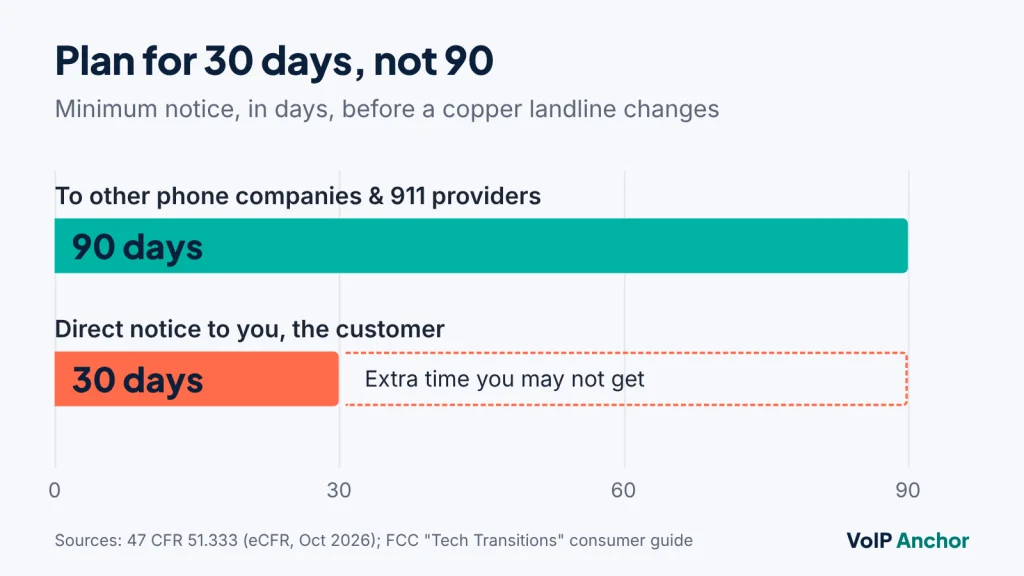
Many guides say you will get 90 days’ notice before your landline goes. That 90-day rule mainly covers notice to other phone companies and 911 providers, not to you. Plan around 30 days instead.
| Item | What it is | Cost or rule | Source and date checked |
| Copper retirement notice | Notice the old carrier must give to connected carriers and 911 providers | At least 90 days (15 if the copper serves no customers) | 47 CFR 51.333, Oct 22, 2026 |
| Direct letter about copper retirement | A personal notice about the network change itself | Not required by FCC rules | FCC Tech Transitions guide, Oct 22, 2026 |
| Notice before service changes | Direct notice before service is discontinued, reduced or impaired | 30 days | FCC Tech Transitions guide, Oct 22, 2026 |
| Time to object | Window to file comments after that notice | 15 days | FCC Tech Transitions guide, Oct 22, 2026 |
| VoIP 911 address | Your provider must record your physical address before service starts | Required | FCC VoIP and 911 guide, Oct 22, 2026 |
| Direct 911 dialing | Office phone systems installed after Feb 16, 2020 must dial 911 with no “9” first and alert someone on site | Required | FCC Kari’s Law page, Oct 22, 2026 |
In practice, carriers often contact you anyway, because they need access to your building. Real notices can still be short. A telecom analyst posted that Verizon gave her 90 days to leave her copper landline, with no replacement offered. To see planned changes near you, check the FCC’s network change notices or call your state public utility commission. Rules changed in 2026, so recheck the FCC pages before you rely on any date.
Common mistakes to avoid
- Waiting for the letter. Customer notice can be as short as 30 days. Start the LINES check now instead.
- Cancelling copper before the port finishes. You can lose your number. Port first, then cancel.
- Forgetting the alarm line. A dead alarm line may give no warning until there is a fire. Ask your alarm company for an approved replacement.
- Ignoring power. VoIP phones go dark in a blackout without backup. Put your router and phones on a battery backup (UPS).
- Skipping the 911 address. Register the exact street address, floor and suite for every new line.
Frequently asked questions
Is the landline phase out happening everywhere?
Not all at once. Carriers retire copper area by area, and timing depends on each carrier’s plans and FCC approvals. AT&T is aiming to shut down most of its copper by the end of 2029, so check your carrier’s notices and your state utility commission for your area.
Will my business phone number stop working?
Not if you act first. You can usually port your number to a new provider, such as a VoIP service or a mobile carrier. Start the new service, port the number, and cancel copper only after the port is complete.
How much notice will my carrier give me?
The FCC’s consumer guide says carriers must notify customers directly 30 days before they discontinue, reduce or impair a service. The 90-day copper rule mainly covers notice to other carriers and 911 providers. Some customers do receive 90 days, but don’t count on it.
Does VoIP work during a power outage?
Usually not without help. The FCC warns that VoIP may stop during a power outage or internet failure. A battery backup for your router and phones, plus a charged mobile phone, keeps a way to call 911.
What happens to my fire alarm line?
It needs its own plan. Many alarm panels still use copper lines to reach the monitoring center. Ask your alarm company which replacement it approves, such as a cellular communicator or a POTS replacement device, and test it before copper is cut.
Can I object to my landline being discontinued?
Yes, in some cases. The FCC’s guide says the carrier’s notice will list a deadline and a way to file comments or objections, usually within 15 days. The FCC also opened a docket in 2026 for complaints about discontinuance practices.
Bottom line
The landline phase out is no longer a distant plan, and your notice may be only 30 days. Desk phones are easy to replace, but alarms, elevator phones and 911 records need more care. Run the LINES check this week, then read phone number porting before you switch, and follow our News section for updates.
Sources
- FCC Takes Action to Speed Up Rollout of Modern, High-Speed Networks (Federal Communications Commission, March 26, 2026)
- FCC Adopts Copper Retirement, Call Center Onshoring Orders (Broadband Breakfast, March 26, 2026)
- When landline service goes away, consumers and businesses face tough choices (Fierce Network, October 2, 2026)
- 47 CFR 51.333: Notice of network changes and copper retirement (eCFR)
- Tech Transitions: Network Upgrades That May Affect Your Service (FCC consumer guide)
- VoIP and 911 Service (FCC consumer guide)
- 911 Requirements for Multi-Line Telephone Systems (FCC)
- Section 251 Wireline Network Changes (FCC)
Last checked: October 22, 2026