E.164 Format: What It Is & How to Format Numbers (2026)
E.164 format is the global standard for writing phone numbers. Learn its rules, how US and international numbers convert, and where country codes came from.

VoIP Anchor is independent. No provider pays to be featured or reviewed. Our disclosure
On this page
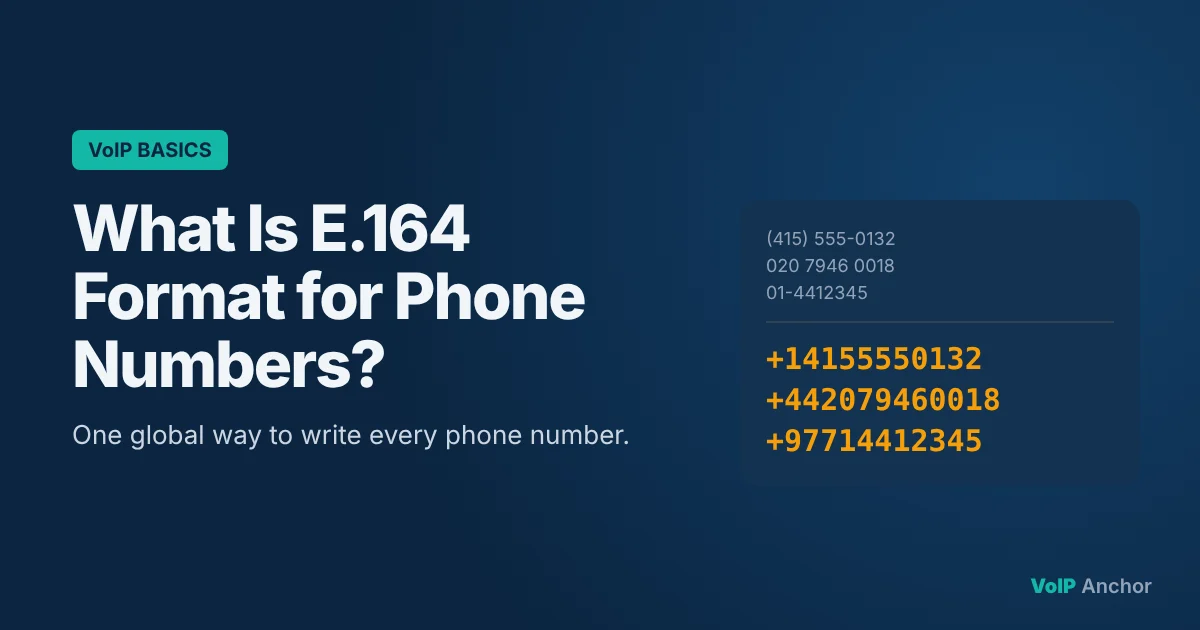
The same US phone number can be written as (415) 555-0132, 415-555-0132, 1-415-555-0132 or 001 415 555 0132, depending on who’s writing it and where they’re calling from. People can usually work it out. Phone systems, SMS platforms and CRMs can’t.
That’s the problem the E.164 format solves. It gives every phone number in the world a single, unambiguous way to be written: +14155550132.
What is E.164 format?
E.164 format is the international standard for writing phone numbers. It comes from ITU-T Recommendation E.164, “The international public telecommunication numbering plan”, published by the International Telecommunication Union (ITU), the UN agency for telecoms.
Work on the standard began in 1984, and the first version was published in 1988. It was revised in 1997 to absorb an older recommendation (E.163), and the current version dates from 2020.
In practice, “E.164 format” means writing a number as a plus sign, the country code and the national number, with no spaces, dashes or brackets.
The key principles of E.164 format
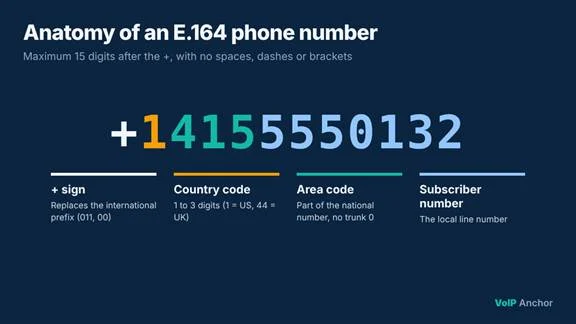
An E.164 number has three parts:
- The plus sign (+): it stands in for whatever international dialling prefix your country uses (011 in the US, 00 in most of Europe and Asia).
- The country code: 1 to 3 digits identifying the country or region, such as 1 for the US or 44 for the UK.
- The national (subscriber) number: everything after the country code, including any area code, written without the local trunk prefix.
Five rules hold everywhere:
- Maximum 15 digits in total, not counting the plus sign.
- Digits only. No spaces, dashes, dots or brackets.
- Always starts with + followed by the country code.
- No international prefix. Leave out 011, 00 and similar codes; the + replaces them.
- No trunk prefix. Drop the leading 0 (or 1 in the US) that you dial for domestic long-distance calls, with a few exceptions such as Italy.
How US numbers look in E.164 format
US numbers belong to the North American Numbering Plan (NANP), which also covers Canada and many Caribbean countries. A NANP number has 10 digits: a 3-digit area code, a 3-digit exchange and a 4-digit line number.
To convert a US number to E.164 format, remove all formatting and add +1 in front:
- (415) 555-0132 → +14155550132
- 1-800-555-0199 → +18005550199
Every US number in E.164 format is 12 characters long: the + plus 11 digits. The “1” Americans dial before long-distance calls is a domestic prefix that happens to match the country code. That’s why US numbers are easy to convert, and why people forget other countries work differently.
How E.164 format works in other countries
Outside the NANP, the main step people miss is dropping the domestic trunk prefix, usually a leading 0.
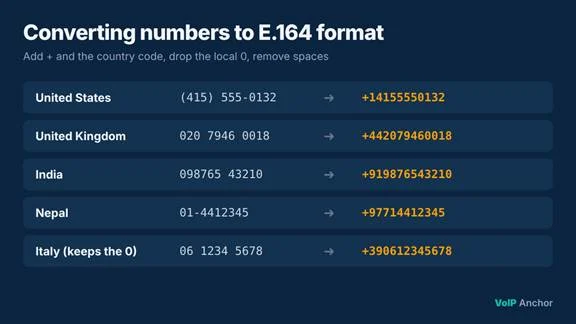
| Country | Code | Number as dialled locally | E.164 format |
| United States | 1 | (415) 555-0132 | +14155550132 |
| United Kingdom | 44 | 020 7946 0018 | +442079460018 |
| Germany | 49 | 030 12345678 | +493012345678 |
| Australia | 61 | (02) 9876 5432 | +61298765432 |
| India | 91 | 098765 43210 | +919876543210 |
| Nepal | 977 | 01-4412345 | +97714412345 |
| Italy (exception) | 39 | 06 1234 5678 | +390612345678 |
Italy is the classic exception: its landline numbers keep the leading 0 in E.164 format. When in doubt, check the country’s numbering rules or use a validation library such as Google’s libphonenumber.
Country codes: where they came from
Country codes are older than E.164 itself. The CCITT, the ITU’s telephone standards body at the time, first defined them in 1960 at a meeting in New Delhi. That first plan covered only Europe, parts of western Asia and some Mediterranean countries.
In 1964, the CCITT extended it into a global system of nine world numbering zones. The first digit of every country code tells you the zone.
The nine world numbering zones
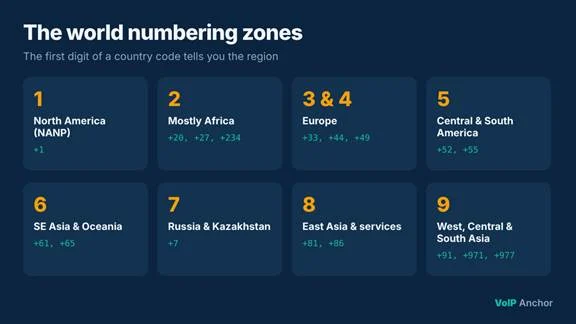
| Zone | Region | Example codes |
| 1 | North American Numbering Plan | +1 US, Canada, Jamaica |
| 2 | Mostly Africa | +20 Egypt, +27 South Africa, +234 Nigeria |
| 3 and 4 | Europe | +33 France, +44 UK, +49 Germany, +353 Ireland |
| 5 | Central and South America | +52 Mexico, +55 Brazil, +507 Panama |
| 6 | Southeast Asia and Oceania | +61 Australia, +65 Singapore, +679 Fiji |
| 7 | Russia and Kazakhstan | +7 |
| 8 | East Asia and special services | +81 Japan, +86 China, +880 Bangladesh |
| 9 | West, Central and South Asia | +91 India, +971 UAE, +977 Nepal |
Why some codes are short and others are long
Codes were handed out by landmass and by how large each country’s network was, or was expected to be, at the time. Countries with big networks, such as the US (+1), Russia (+7) and the UK (+44), got short codes. That leaves more of the 15-digit limit for their national numbers. Smaller networks got three-digit codes, such as Nepal (+977) and Fiji (+679).
Shared country codes
A country code doesn’t always mean a single country:
- +1 is shared by the US, Canada and many Caribbean nations. The area code tells them apart: +1 876 is Jamaica, for example.
- +7 is shared by Russia and Kazakhstan.
Some codes don’t belong to a country at all. The ITU also assigns codes for global services, such as international freephone numbers.
Why E.164 format matters for VoIP, SMS and business tools
For most people, E.164 format is invisible. For anyone running a business phone system, it shows up everywhere:
- VoIP and SIP calling: many providers expect numbers in E.164 format for routing, caller ID and call forwarding rules.
- SMS and messaging APIs: platforms that send texts, including those built on Twilio or Telnyx, generally require recipient numbers in E.164 format.
- CRMs and contact databases: storing every number the same way prevents duplicates and makes click-to-call work reliably.
- International calling: a number saved as +44 20 7946 0018 works from any country. One saved as 020 7946 0018 only works inside the UK.
- Verification and compliance: two-factor logins, caller ID checks and messaging registration all match numbers more reliably when they’re stored consistently.
A simple habit that helps: store numbers in E.164 format in your systems, and format them for people (with spaces or brackets) only when you display them.
Frequently asked questions
What is an example of a number in E.164 format?
The US number (415) 555-0132 in E.164 format is +14155550132. The UK number 020 7946 0018 becomes +442079460018.
How many digits can an E.164 number have?
Up to 15 digits, not counting the plus sign. US numbers use 11 digits: the country code 1 plus the 10-digit number.
Does E.164 format include spaces or dashes?
No. E.164 format is digits only after the plus sign. Spaces and dashes are added only when displaying a number for people to read.
Is the + sign required in E.164 format?
The ITU standard defines the digits, and the + is the accepted way to write a number internationally. Most phone systems and messaging APIs expect the + to be included.
Do I drop the leading 0 when converting to E.164?
In most countries, yes. The leading 0 is a domestic trunk prefix. Italy is a well-known exception, where landline numbers keep it.
Final thoughts
E.164 format is a simple rule with a big impact: a plus sign, a country code and the national number, with nothing else. Whether you’re setting up a VoIP system, sending business texts or cleaning up a CRM, storing numbers in E.164 format keeps calls and messages going where they should, in any country.