What is SIP Trunking? A Simple Guide for Businesses
SIP trunking replaces old phone lines with internet-based connections for your business phone system. Here is how it works, what it costs, and whether you need it.

VoIP Anchor is independent. No provider pays to be featured or reviewed. Our disclosure
On this page
If your business still runs a phone system in the office, someone has probably suggested “moving to SIP trunks”. It sounds technical, but the idea is simple: keep the phone system you already have, and replace the old phone lines with a connection over the internet.
This guide explains what SIP trunking is, how it works step by step, what it costs, how many channels you need, and how it compares with a fully hosted VoIP system. By the end, you’ll know whether SIP trunking suits your business and what to check before you switch.
Key takeaways
- SIP trunking connects your own business phone system (PBX) to the public phone network over the internet instead of physical phone lines.
- You pay for capacity in channels, where one channel carries one call, and you can add or remove channels in minutes.
- It suits businesses that already own a PBX, need many lines, or want more control than a hosted phone service offers.
- Call quality depends on your internet connection, router settings and security setup, so plan these before you switch.
What is SIP trunking?
SIP trunking is a way of connecting a business phone system to the public telephone network over an internet connection, rather than through copper phone lines or digital circuits.
Two terms make it easier to understand:
- SIP (Session Initiation Protocol) is the signalling standard most VoIP systems use to set up, manage and end calls. It is the “language” your phone system and your provider use to talk to each other.
- A trunk is a shared line that carries many calls at once. Traditionally, trunks were bundles of copper pairs or digital circuits such as T1 and PRI lines, each with a fixed number of call paths.
A SIP trunk is a virtual version of those lines. Your calls travel as data, and the number of calls you can make at the same time depends on your plan and your bandwidth, not on how many physical wires come into the building.
What is a PBX?
A PBX (private branch exchange) is the phone system that manages calls inside your business: extensions, transfers, voicemail, call queues and menus. It can be a box in a server room, a virtual machine in your own cloud, or software such as an open-source PBX. SIP trunking is the link between that PBX and the outside world.
How SIP trunking works, step by step
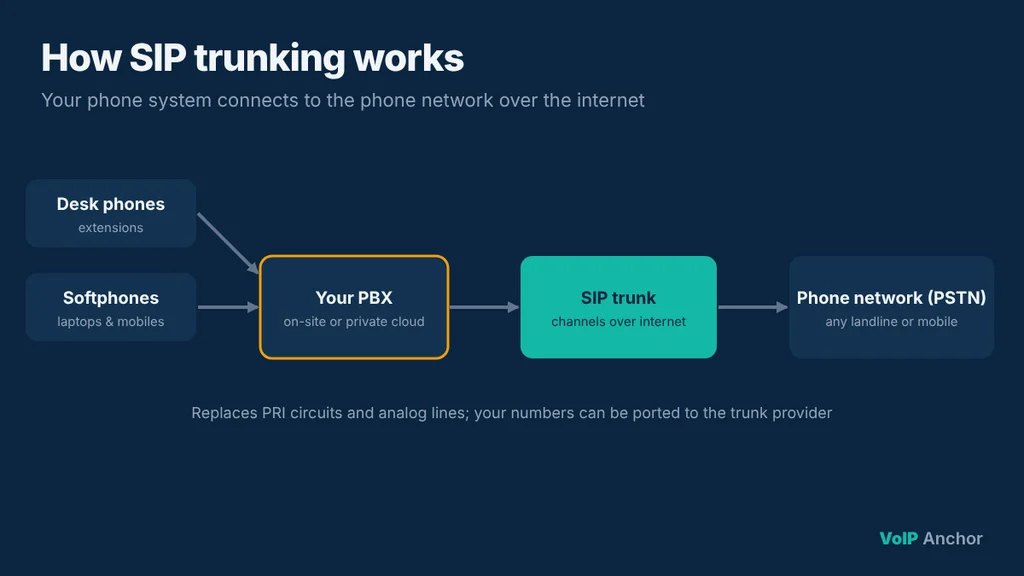
- Your phone system stays in place. Desk phones and softphones connect to your PBX as they always have. Older PBXs that don’t speak SIP can connect through a gateway that converts their signals.
- The PBX registers with your SIP trunk provider. It connects over your internet connection or a private network link, using login details or an approved IP address.
- Outgoing calls travel as data. When someone dials out, the PBX sends the call to the provider using SIP for signalling and a codec (a method of compressing voice) for the audio.
- The provider connects to the phone network. The provider hands the call to the public telephone network, so it reaches any landline or mobile number.
- Incoming calls follow the same path in reverse. Calls to your numbers reach the provider first, travel down the trunk to your PBX, and the PBX rings the right extension, queue or menu.
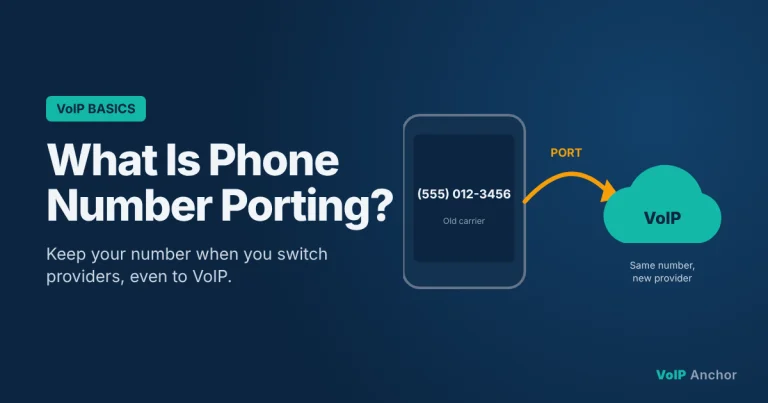
Your existing phone numbers can usually be moved to the SIP trunk provider through number porting, so customers keep calling the same numbers and notice no change.
SIP channels: how many do you need?
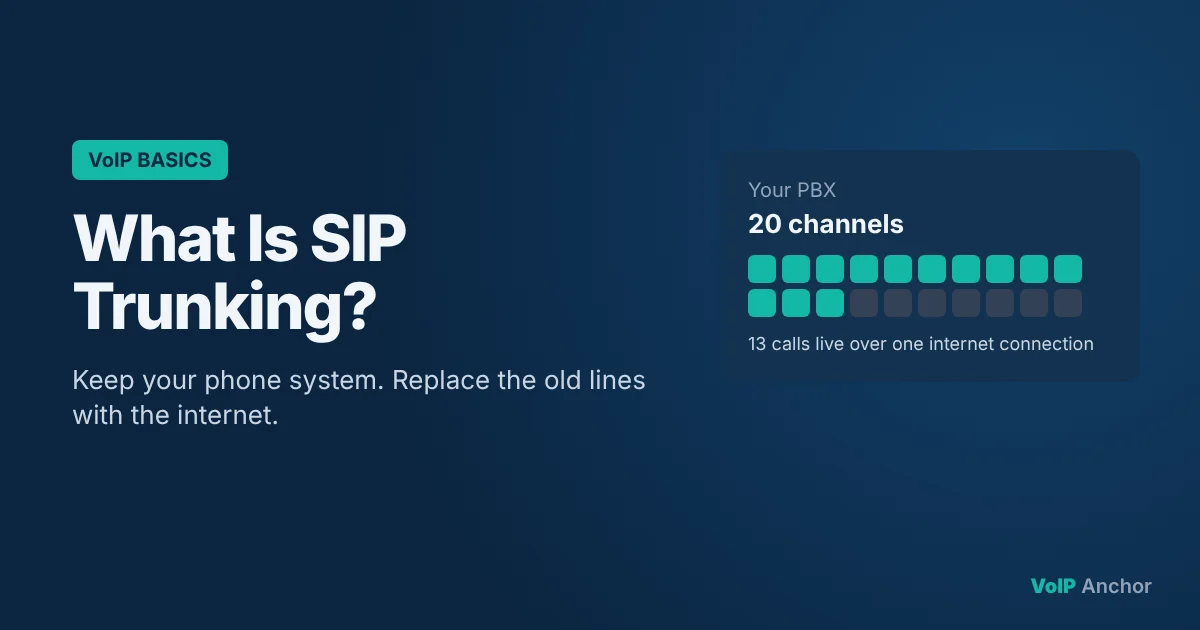
SIP trunks are sized in channels, sometimes called concurrent call paths. One channel carries one call, inbound or outbound. You don’t need one channel per employee, only enough for the busiest moment of your day.
A simple way to estimate channels
- Look at your current phone bill or PBX reports and find the highest number of calls that were active at the same time.
- If you don’t have reports, estimate how many people are ever on the phone at once during your busiest hour.
- Add a buffer of 10–20% for growth and unexpected peaks.
For example, a 25-person office where no more than eight people are ever on calls at the same time might start with ten channels. A small contact centre with 15 agents who are on the phone most of the day would need closer to 15–18 channels.
Bandwidth per channel
Each call uses internet bandwidth in both directions. A common rule of thumb is around 100 kbps per call each way with the G.711 codec, including network overhead, and less with compressed codecs such as G.729. Ten simultaneous calls would therefore need roughly 1 Mbps up and down reserved for voice, on top of your other internet use.
Benefits of SIP trunking
Lower costs
SIP trunks are often cheaper than PRI circuits or multiple analogue lines. You stop paying for fixed line rental and, depending on the plan, can get unlimited domestic calling or low per-minute rates for long-distance and international calls.
Scale up or down quickly
Need more capacity for a busy season or a new team? Add channels from your provider’s portal, usually within minutes, and remove them when you no longer need them. There’s no new wiring and no waiting for an engineer.
Keep your existing investment
If you already own a PBX that works well, SIP trunking lets you modernise your lines without replacing the whole phone system or retraining staff on new phones.
Local numbers anywhere
Add phone numbers in other cities or countries and route them to your office. A business in one city can have a local presence in several markets without opening new locations.
Better business continuity
If your office loses power or internet, many providers can automatically reroute calls to mobile phones, another office or voicemail, so callers never hear a dead line.
Ready for the end of copper
As carriers retire traditional copper lines, businesses with an on-site PBX need a new way to connect. SIP trunking is one of the most common answers.
Things to plan before you switch
Internet quality
Voice is sensitive to delay. You need a stable connection with low latency, jitter and packet loss. A business-grade connection, ideally with a backup line, is worth the cost if phones are critical to your business. Turn on QoS (quality of service) on your router so voice traffic gets priority over large downloads.
Router and firewall settings
A router feature called SIP ALG often causes one-way audio and dropped calls on SIP trunks. Most providers ask you to turn it off. Your firewall also needs to allow SIP and audio traffic from your provider.
Security and toll fraud
An exposed PBX can be targeted by criminals who make expensive international calls at your cost. Protect yourself with strong passwords, IP address restrictions, blocked international destinations you don’t call, and spending limits with your provider.
Emergency calling
Every number must have the correct emergency address registered with your provider. Multi-line systems must also meet Kari’s Law and RAY BAUM’S Act requirements, including direct 911 dialling and accurate location information.
Who manages the PBX
With SIP trunking, you still own and maintain the phone system, including updates, security patches and configuration. Make sure you have the skills in-house or an IT partner who can do it.
SIP trunking vs hosted VoIP
Both use VoIP. The difference is where the phone system lives and who looks after it.
| SIP trunking | Hosted (cloud) VoIP | |
| Phone system (PBX) | You own it, on-site or in your own cloud | The provider runs it in the cloud |
| What you buy | Channels and phone numbers | A complete phone service per user |
| Best for | Businesses with an existing PBX, contact centres, IT teams that want control | Small and remote teams that want little to maintain |
| Pricing | Per channel or per minute | Per user per month |
| Maintenance and updates | Your team or IT partner | The provider |
| Customisation | Very high | Limited to the provider’s features |
| Upfront cost | Higher if you need to buy a PBX | Low; mainly phones or apps |
If you’re starting from scratch with a small team, hosted VoIP is usually simpler. If you already have a PBX you’re happy with, run a contact centre, or need detailed control over call routing and integrations, SIP trunking is often the better fit.
How much does SIP trunking cost?
Pricing varies by provider and country, but most plans use one of these models:
- Per channel: a fixed monthly fee for each concurrent call path, often with unlimited or bundled domestic minutes. Easy to budget for.
- Metered: a low base fee plus a per-minute rate. Cheaper for businesses with low or unpredictable call volumes.
- Hybrid: a set number of channels with included minutes, plus per-minute rates above that.
On top of the channel or minute costs, expect separate charges for:
- Phone numbers, including toll-free numbers
- Emergency calling (E911) per number
- International calls
- Porting fees, if your provider charges them
To compare providers fairly, take a typical month of calls and work out the total cost under each plan rather than comparing headline channel prices.
How to switch to SIP trunking
- Audit your current setup. List your phone lines, numbers, PBX model and the features you rely on.
- Check your PBX is compatible. Most modern IP PBXs support SIP. Older systems may need a gateway or a software upgrade.
- Test your internet connection. Run a VoIP quality test and confirm you have enough bandwidth for your peak number of calls.
- Choose a provider and plan. Compare pricing models, coverage, support and failover options.
- Set up and test the trunk with a temporary number before moving your main numbers.
- Port your numbers. Keep your old lines active until the port completes.
- Cancel the old lines only after everything has worked well for a few days.
Frequently asked questions
Is SIP trunking the same as VoIP?
SIP trunking is one type of VoIP. VoIP is the broad technology of making calls over the internet. SIP trunking specifically connects your own phone system to the public phone network.
Do I need a PBX for SIP trunking?
Yes. A SIP trunk connects a phone system to the network, so you need a PBX, either on-site or in your own cloud. Without one, a hosted VoIP service is usually the better choice.
How many SIP channels do I need?
Count the highest number of calls your business has at the same time, then add a 10–20% buffer. Most offices need far fewer channels than they have employees.
Can I keep my phone numbers with SIP trunking?
Yes. Most numbers can be ported to a SIP trunk provider. Keep your old service active until the port is complete.
Is SIP trunking reliable?
With a good internet connection, QoS and a provider that offers automatic failover, SIP trunking is as reliable as traditional lines for most businesses.
Is SIP trunking secure?
It can be. Use strong passwords, restrict access to your provider’s IP addresses, block destinations you don’t call, set spending limits and keep your PBX updated.
Final thoughts
SIP trunking lets you keep the phone system you already have while moving your lines to a cheaper, more flexible internet connection. For businesses with an on-site PBX, especially as copper lines are retired, it is often the simplest route to modern calling.
Before you switch, check your internet quality, size your channels, secure your PBX and register your emergency addresses. Then port your numbers once the trunk has been tested.