
What Is Phone Number Porting?A Complete Guide for 2026
Your phone number isn’t tied to your carrier. Here’s what phone number porting is, the rules that protect it, and why moving your number to VoIP can save businesses and travellers money.

VoIP Anchor is independent. No provider pays to be featured or reviewed. Our disclosure
On this page
- Phone numbers and ownership: who really controls your number?
- What is phone number porting?
- Why people choose to port their number
- The history and legal rules behind number porting
- How phone number porting works, step by step
- Why port your number to VoIP?
- Before you port: a quick checklist
- Frequently asked questions
- Final thoughts
Your phone number is probably older than your current phone, and maybe older than your current provider. Customers, suppliers, banks and old friends all know it. Changing it means lost calls, reprinted business cards and a lot of “please update your records” emails.
That’s why phone number porting exists. It lets you move your existing number from one provider to another, including from a mobile carrier or landline to a VoIP service, without changing a single digit.
This guide explains who actually controls your number, what porting is, the rules that protect it, how the process works, and why porting to VoIP is a smart move for many businesses and frequent travellers.
Phone numbers and ownership: who really controls your number?
In the US, phone numbers follow the North American Numbering Plan (NANP), the 10-digit format of area code, exchange and line number. Numbers are a public resource. The FCC oversees them, and an administrator assigns blocks of numbers to carriers, which then assign individual numbers to customers.
That means, strictly speaking, you don’t own your phone number the way you own your phone. What you have is the right to use it and to take it with you. As long as your account is active, US law lets you move the number to another provider in the same area.
A few practical points follow from this:
- Your number belongs with the account holder. On a business line, that’s whoever is named on the account, which is usually the company, not the employee using it.
- Cancelling service can mean losing the number. If you close the account before porting, the number goes back to the carrier and can be reassigned to someone else.
- Every number has a home area. Each number is tied to a local rate centre. That matters for landline ports and is one reason VoIP is more flexible.
What is phone number porting?
Phone number porting is the process of moving an active phone number from one service provider to another. The provider you’re leaving is the losing carrier, and the one you’re moving to is the gaining carrier. Once the port completes, calls and texts to your number simply start arriving through the new provider.
In the US, the legal term is local number portability (LNP). Porting works across service types:
- Mobile to mobile: for example, switching from one wireless carrier to another.
- Landline to mobile: retiring a home line but keeping the number.
- Landline or mobile to VoIP: moving the number to an internet-based phone system that works through apps, desk phones and computers.
- Toll-free numbers: 800, 888 and similar numbers can also be moved between providers, through a separate process.
Why people choose to port their number
Most people port because their number is worth more than any single provider. Common reasons include:
- Better pricing or features. A new provider offers lower costs, unlimited calling, call recording or a business phone system.
- Business continuity. A number printed on invoices, Google Business Profile listings, ads and vehicles is part of a company’s identity. Changing it costs leads.
- Moving to VoIP. Businesses outgrowing a single mobile or landline want call routing, multiple users and apps on the same number.
- Consolidation. Teams bring scattered mobile and landline numbers under one provider and one bill.
- Life changes. People move cities, travel for long stretches or retire a landline but want to stay reachable on the number everyone knows.
The history and legal rules behind number porting
Keeping your number wasn’t always possible. Until the late 1990s, switching phone companies in the US meant getting a new number, which kept customers locked in. Phone number porting rules changed that one step at a time.
Key milestones in the US
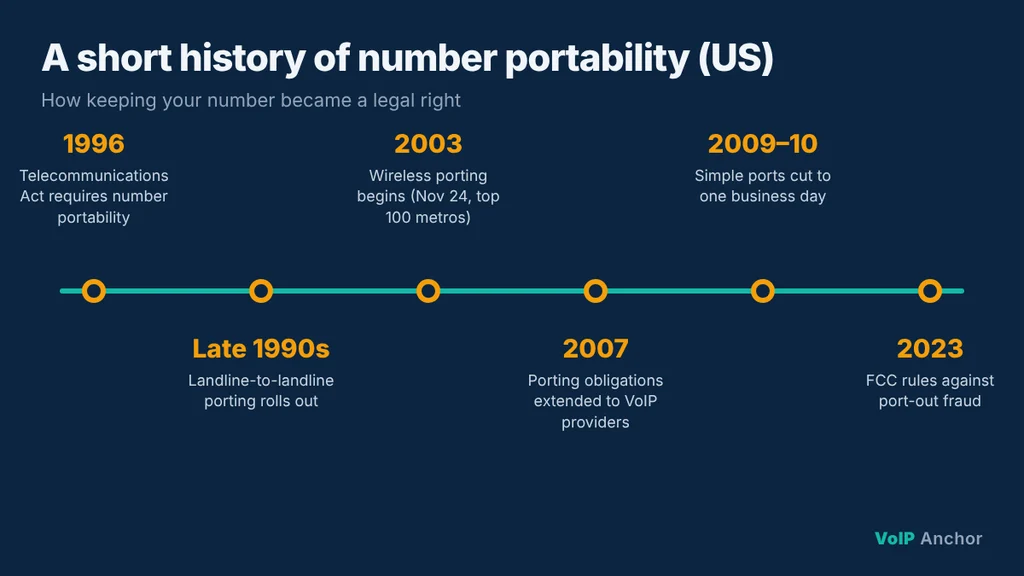
- 1996: The Telecommunications Act required local carriers to offer number portability, to encourage competition.
- Late 1990s: Landline-to-landline porting rolled out across major markets.
- November 24, 2003: Wireless number portability began in the top 100 metro areas, with most other areas following by May 2004. For the first time, mobile users could switch carriers and keep their number.
- November 2007: The FCC extended porting obligations to interconnected VoIP providers, so numbers could move to and from VoIP services.
- 2009–2010: The FCC cut the deadline for “simple” ports (a single line with no complex features) from four business days to one business day.
- November 2023: The FCC adopted rules against SIM-swap and port-out fraud. Wireless carriers must securely verify customers, notify them about port-out requests, and offer a free account lock that blocks ports.
Other countries have their own versions. The UK, EU member states, India and many more require number portability, with different rules and timelines.
Your rights when you port (US)
According to the FCC’s consumer guide to porting, a few protections apply:
- Your old provider can’t refuse to port your number because you owe money. You still owe the balance, but they can’t hold the number hostage.
- Simple ports should complete within one business day. Mobile-to-mobile ports often finish within hours, while landline and VoIP ports can take longer in practice.
- Porting fees may apply, but they’re often waived or negotiable.
- Don’t cancel your old service first. Keep it active until the port completes, or you risk losing the number.
How phone number porting works, step by step
Phone number porting looks complicated from the outside, but you only handle the first two steps. The providers handle the rest.
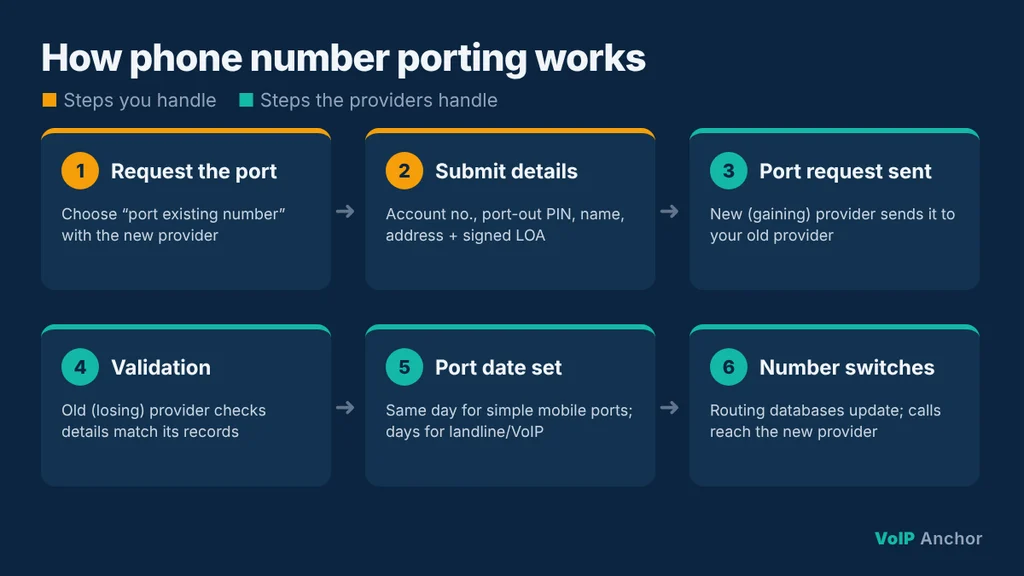
- Request the port with your new provider. Sign up with the gaining carrier and choose “port an existing number” instead of getting a new one.
- Submit your details and authorisation. You’ll provide the account holder’s name, service address, account number, a port-out PIN (for mobile numbers) and sign a Letter of Authorization (LOA). Some providers also ask for a recent bill.
- The new provider sends the port request. The gaining carrier submits it to your current provider.
- Your old provider validates it. The losing carrier checks that the name, address, account number and PIN match its records. Most rejections happen here, usually because of a small mismatch.
- A port date is confirmed. Simple mobile ports can happen the same day. Landline and VoIP ports commonly take several business days.
- The number switches over. On port day, the national routing databases are updated, so calls and texts route to the new provider. Your old service for that number ends automatically.
Tip: Set up your new VoIP app, desk phones and call routing before port day, so calls land in the right place from the first minute.
Why port your number to VoIP?
With VoIP, your number isn’t tied to a SIM card or a copper line. It lives in the cloud and works anywhere you have an internet connection, through a mobile app, a desktop app or a desk phone. That opens up uses a traditional line can’t match.
Benefits for businesses
- Many people on one number. Calls to your main number can ring several team members at once, follow a schedule or go through a menu (“press 1 for sales”).
- Work from anywhere. Remote and hybrid teams answer the business number from their laptop or phone, without sharing personal numbers.
- Professional features. Voicemail-to-email, call recording, business hours, analytics and CRM integrations come standard with most VoIP plans.
- Lower costs. VoIP plans are often cheaper than business landlines, especially for long-distance and multi-line setups.
- No disruption. Customers keep calling the same number they’ve always used.
This suits small businesses that started on a personal mobile number, local service businesses with a long-standing landline, and growing sales or support teams.
Staying reachable abroad without roaming charges
Phone number porting is also useful if you’re spending weeks or months away from home: a long trip, remote work from another country, or extended time with family overseas.
International roaming plans and daily passes add up quickly over a long stay. Turning roaming off avoids the bill, but then you miss calls and texts from the number everyone knows.
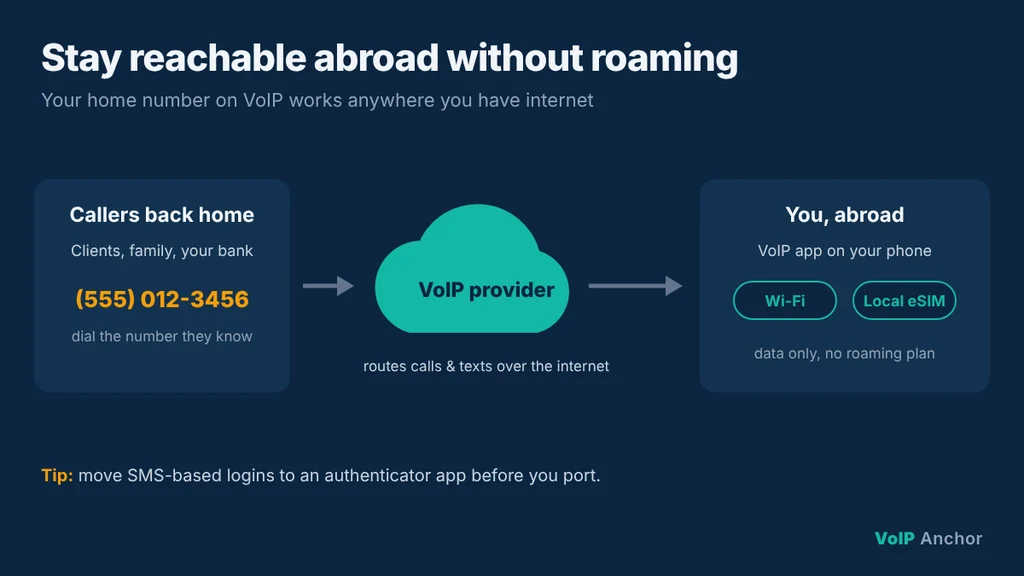
Phone number porting to VoIP solves both problems:
- Before you leave, port your mobile number to a VoIP provider that supports calling and texting in its app.
- Abroad, buy a cheap local SIM or travel eSIM for data, or simply use Wi-Fi.
- Use the VoIP app to make and receive calls and texts on your home number over the internet, usually at domestic rates.
- Back home, keep the number on VoIP, or port it back to a mobile carrier.
Friends, clients and your bank’s customer-service line see the same number they always have, and you avoid roaming charges entirely.
Two things to plan for. First, some banks and apps don’t send one-time passcodes (OTP) by SMS to VoIP numbers. Switch those accounts to an authenticator app, or confirm they work with VoIP, before you port. Second, once the number moves, your old mobile plan for that line ends, so decide whether you also need a separate mobile number.
Before you port: a quick checklist
Most failed phone number porting requests come down to preparation. Run through this list first:
- Keep your current service active until the port is complete.
- Get your account number and port-out PIN from your current carrier. Most mobile carriers let you generate a PIN in their app or account page.
- Match details exactly. Use the account holder name and service address as they appear on your bill.
- Remove any port lock or freeze on the account, if you’ve turned one on.
- Check for contracts and device balances. Porting ends the line, which can trigger early termination fees or remaining device payments.
- Confirm the new provider covers your number’s area. Most VoIP providers support nearly all US area codes, but check before signing up.
- Move two-factor logins to an authenticator app if you’re switching a mobile number to VoIP.
- Ask about texting. Make sure SMS is enabled on the number after the port, not only voice.
- Plan the timing. Avoid porting a business number on your busiest day.
Frequently asked questions
How long does phone number porting take?
Simple mobile-to-mobile ports often finish within a few hours. FCC rules set one business day for simple ports, but landline, multi-line and VoIP ports commonly take several business days to two weeks in practice.
Is phone number porting free?
Often, yes. Some providers charge a small porting fee, and some carriers charge to port out. Ask both providers, since fees are frequently waived.
Can I port a number if I still owe my carrier money?
Yes. In the US, your provider can’t block a port because of an unpaid balance, though you’ll still owe that balance.
Can I port my mobile number to VoIP?
Yes. Most business VoIP providers accept mobile numbers. Check that the provider supports texting on ported numbers, and move any SMS-based logins to an authenticator app first.
Will I lose service during the port?
Usually only for a few minutes, or not at all. Keep your old service active until the new provider confirms the port is complete.
Can I port my number back later?
Yes. The same portability rules apply, so you can move the number back to a mobile carrier or to another VoIP provider.
Final thoughts
Your phone number is one of your most valuable contact details, and phone number porting makes sure you never have to give it up just to change providers. For businesses, porting to VoIP adds flexibility and professional features without losing the number customers already trust. For travellers, it means staying reachable on your home number from anywhere with an internet connection, without paying for roaming.
If you’re planning a switch, start with the checklist above and keep your current service active until the port is confirmed.

2 Comments