STIR/SHAKEN: Why Verified Business Calls Still Show Spam Likely
“Spam Likely” doesn’t mean you broke a rule. Here’s what STIR/SHAKEN checks, what the 2026 data shows, and how to fix a flagged number.

VoIP Anchor is independent. No provider pays to be featured or reviewed. Our disclosure
On this page
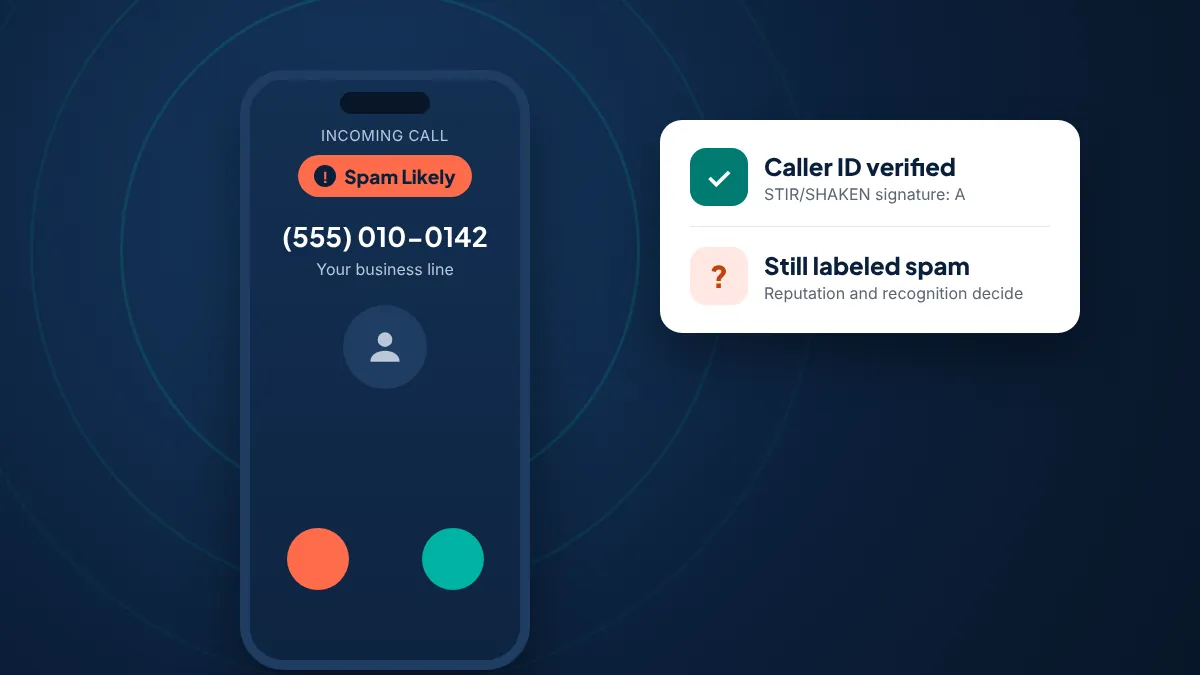
Your customer sees “Spam Likely,” declines the call, and never learns it was you. The fix is rarely a new number. It’s checking three layers: your signature, your reputation and your recognition.
What does “Spam Likely” mean, and who decides?
“Spam Likely” is a warning label a carrier or call-analytics company shows when it thinks a call may be unwanted. It is not an FCC finding against your business.
No single master list controls every phone. Carriers rely on analytics companies such as First Orion, Hiya, Nomorobo, TNS Call Guardian and YouMail, according to Bandwidth. Each one uses its own data and thresholds.
That’s why one call can look different on different networks. T-Mobile says its “Scam Likely” label appears when it “identifies an incoming call as a likely scam.” Other carriers and apps use their own wording, or no label at all.
These labels exist to catch spoofing. The FCC defines spoofing as when a caller “deliberately falsifies” what your caller ID shows.
STIR/SHAKEN in plain English
STIR/SHAKEN is a set of standards that lets phone companies check whether caller ID is genuine. Your provider signs each call, and the receiving carrier checks that signature before the phone rings.
The name joins two parts. STIR (Secure Telephone Identity Revisited) comes from an IETF working group, and SHAKEN is the industry framework for using it on phone networks. The FCC explains that originating carriers sign caller ID “as legitimate,” and other carriers validate it.
Think of it as a tamper-evident seal on a package. It shows where the call started. It says nothing about whether your customer wants the call.
New to internet-based calling? Our guide to VoIP explained covers how these calls travel.
What are STIR/SHAKEN attestation levels A, B and C?
When your provider signs a call, it adds an attestation level. The level shows what the provider can vouch for, not whether the call is welcome.
| Level | Name | What your provider can vouch for |
|---|---|---|
| A | Full attestation | It knows you, and it knows you’re linked to the number shown. |
| B | Partial attestation | It knows you, but not your link to the number shown. |
| C | Gateway attestation | It’s passing the call along and can’t confirm where it started. |
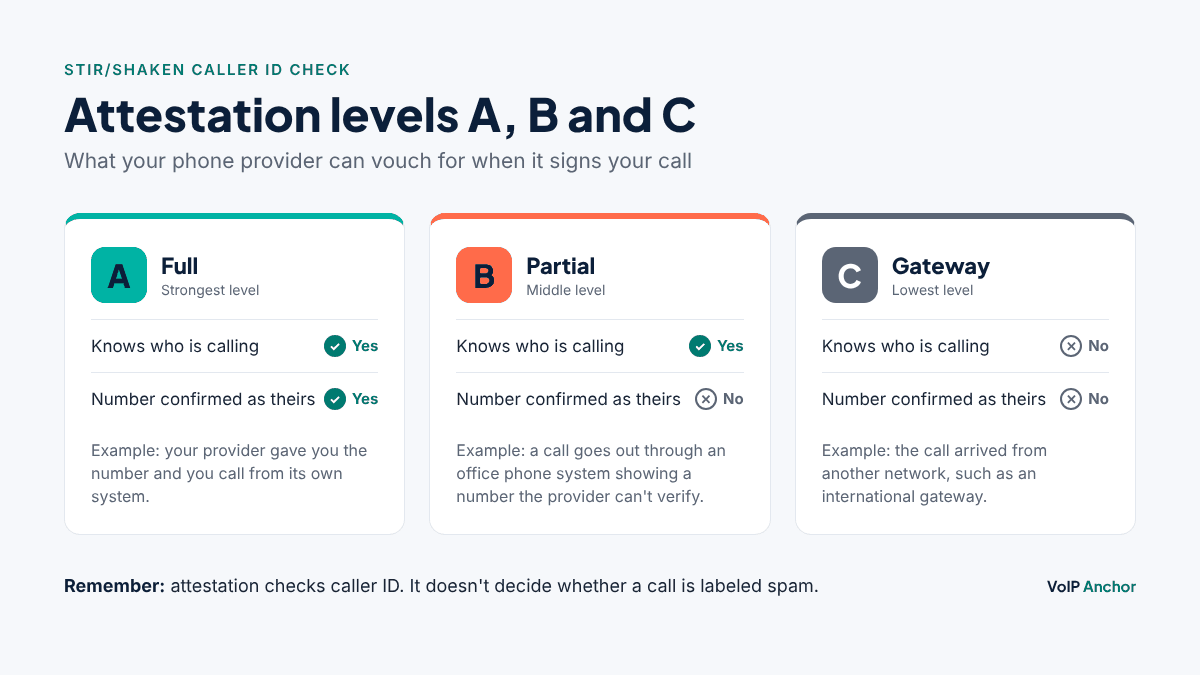
A lower level isn’t proof of wrongdoing. Calls through a third-party platform, call forwarding or an office phone system can be harder to verify fully.
FCC rules took effect on September 18, 2025. Providers with a STIR/SHAKEN obligation must now make “all attestation level decisions” themselves and sign calls with their own certificate (Federal Register, August 2025). So the provider you pay is the right one to ask about your level.
What the 2025–2026 STIR/SHAKEN data shows
STIR/SHAKEN now covers most calls between the biggest carriers, but wide gaps remain elsewhere. The data also shows that an A rating doesn’t prove a call is wanted.
VoIP Anchor analysis of the cited sources:
| Finding | Figure | Source and date | What it means for you |
|---|---|---|---|
| Calls between tier-1 carriers that were signed | 86% (2024) | TNS Robocall Report, Feb 2025 | Calls between big networks usually carry a signature. |
| Change in signed calls between smaller carriers | Fell nearly 25% (2024) | TNS, same report | Smaller networks are the weak spot. |
| Calls arriving with a signature intact | 38.2% (July 2025) | TransNexus, Aug 2025 | Many calls lost their signature on the way. |
| Calls arriving with a signature intact | 54.8% (Aug 2026) | TransNexus, Sept 2026 | Coverage improved, but nearly half still arrive unsigned. |
| Calls from the top ten robocall-signing providers with an A rating | 71% (Aug 2026) | TransNexus, same report | Robocallers can get A ratings too. |
| Unknown calls that go unanswered | 86% | Hiya State of the Call 2026 | An unrecognized number loses most calls, label or not. |
Two more numbers follow from TransNexus’s August 2026 figures. About 45% of calls (100% minus 54.8%) arrived with no signature. A-level calls were 33.8% of all calls, so they made up about 62% of signed calls (33.8 ÷ 54.8).
Keep the sample in mind. TransNexus measures calls received by providers that use its tools, not every US call. TNS describes its own traffic analysis.
Does an A rating keep you off spam lists?
The A-rating myth: The data says an A rating is no shield. In August 2026, 71% of the calls signed by the ten providers that signed the most robocalls carried an A rating (TransNexus). That’s why Bandwidth notes that attestation “is not the same as” spam identification.
The gap is widest on smaller networks. TNS general manager Seth Walton warned that “non-top carriers’ networks remain at serious risk” (TNS, Feb 2025).
Why do honest business calls still get flagged?
Analytics systems judge patterns, not intent. Normal business activity can look a lot like unwanted calling.
Businesses often can’t see what went wrong. Hiya CEO Alex Algard said businesses have been “left in the dark about why their calls were flagged as spam” (Hiya, September 2025). The same release cites Hiya’s 2025 State of the Call report: 60% of sales professionals said they lost a deal because of call-related issues.
Common triggers include:
- Sudden call volume. A new campaign, a seasonal rush or a brand-new number creates a sharp change in calling patterns.
- Complaints or blocks. People report or block calls they don’t recognize, even from real businesses.
- Recycled numbers. A number may carry a history from its previous owner.
- Inconsistent caller ID. Showing numbers that don’t match your business or area undermines trust.
- Weak attestation. Calls routed through several providers or gateways may lose the strongest level.
- Misconfigured systems. Wrong caller ID settings or rotating numbers make normal calls look odd.
These are common triggers, not a diagnosis. Each carrier and analytics company weighs signals differently and doesn’t publish every rule.
How to check and fix a “Spam Likely” label
Start with evidence from customers, then work through your provider, the free registries and the carriers. Most steps cost nothing.
Step 1: Collect specific examples
Ask customers which number called them, which carrier they use, what label they saw, and when. Note whether the label came from the phone itself or a separate app. Specific examples are what providers can investigate.
Step 2: Check your caller ID and attestation with your provider
Confirm that every team, platform and location shows a number your business is allowed to use. Then ask your provider what STIR/SHAKEN attestation level your calls get. Ask what it needs from you to give A-level attestation where it fits.
Step 3: Register your numbers for free
The Free Caller Registry is brought to you by First Orion, Hiya and TNS, three companies that supply call protection to carriers. You can add up to 20 numbers by hand or upload a file. It asks for your call purpose and monthly outbound call volume.
Next, use First Orion’s free number registration, where the old calltransparency.com address now points. First Orion says it vets your number across major carriers “at no cost.”
Step 4: Use each carrier’s feedback channel
If customers on one network see the label, use that carrier’s official tools. Verizon’s Call Filter terms say users can give feedback on calls they “believe were mislabeled as spam.” Keep a log of every form you submit and when.
Step 5: Make your calls expected
Tell customers which number you’ll call from, why, and roughly when. Leave a short voicemail with your business name and a callback number. This won’t change a carrier’s label, but it helps customers recognize you.
Step 6: Steady your volume, then escalate
Ramp up new numbers slowly, and follow consent, calling-hour and do-not-call rules. If your team uses an auto-dialer, our guide to power vs. predictive dialers covers the compliance risks. If a campaign launch lines up with the first complaints, share that timeline with your provider. If the problem continues, ask it to review routing, signing and caller ID settings.
Blocked calls vs. labeled calls: what changed in 2026
A new FCC rule took effect on March 25, 2026. When a terminating provider blocks a call based on analytics, it must return SIP code 603+, and every provider in the call path must pass it back (Federal Register, March 2025). SIP 603+ is a technical signal that travels back to the caller’s provider.
The rule covers blocked calls, not labels. If your calls fail outright, ask your provider whether it received 603+ codes. That tells you a block happened, which gives you a concrete starting point for a dispute.
The Three-Layer Caller Trust Model
Every “Spam Likely” problem sits in one of three layers. Check them in order, because each layer has a different owner.
| Layer | Question it answers | Who controls it | Your action |
|---|---|---|---|
| 1. Signature | Is the caller ID genuine? | Your phone provider | Confirm your attestation level and caller ID setup. |
| 2. Reputation | Does this number behave like spam? | Analytics companies and carriers | Register numbers, keep volume steady, dispute labels. |
| 3. Recognition | Will the customer pick up? | You and your customer | Share your number in advance and leave clear voicemails. |
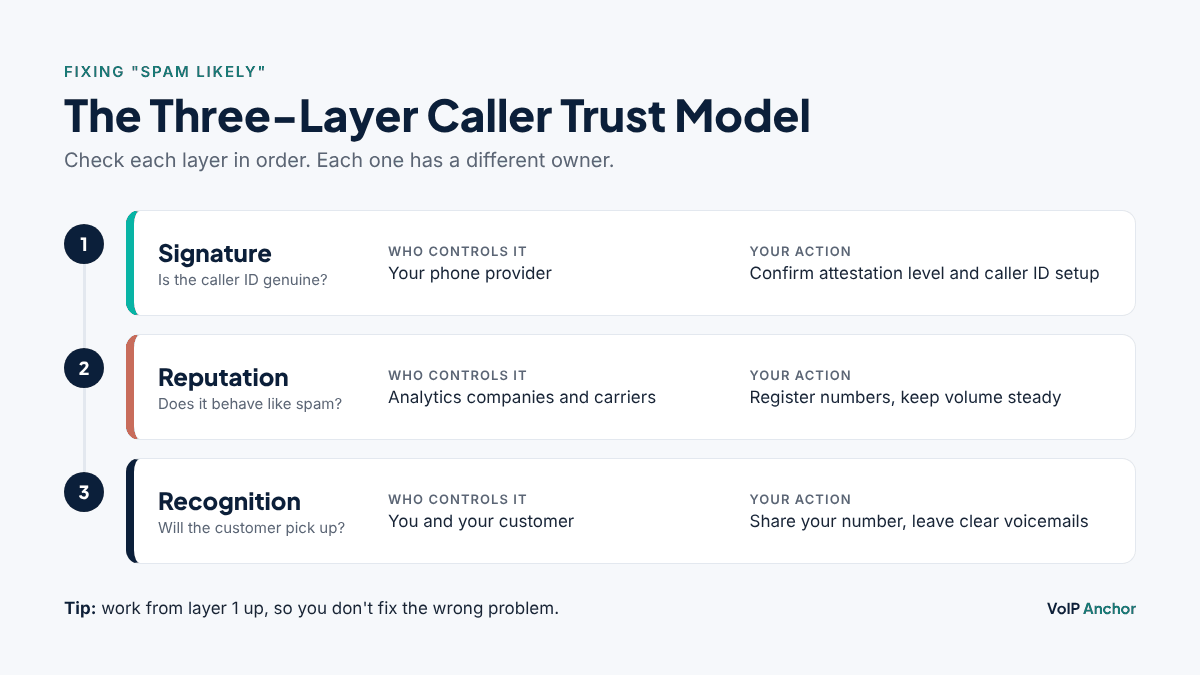
The signature layer is the foundation, but it can’t carry the load alone. A perfect A rating won’t help if your reputation is poor. A clean reputation won’t help if customers don’t know your number.
Most businesses jump straight to layer 2 or swap numbers. Working from layer 1 up avoids fixing the wrong problem.
Common mistakes the model prevents
- Treating STIR/SHAKEN as a spam shield. It checks caller ID, not whether a call is welcome.
- Assuming the label proves misconduct. “Spam Likely” is a provider’s judgment, not an FCC ruling.
- Changing numbers to outrun a label. New numbers start with no reputation and confuse customers. If you switch providers, port your number instead.
- Letting someone else register for you. The Free Caller Registry asks you to certify you’re the business using the numbers.
- Expecting instant removal. No carrier publishes a standard timeline.
FAQ
How do I remove “Spam Likely” from my business number?
There’s no single switch. Register your numbers with the Free Caller Registry and First Orion, then ask your provider to check your caller ID setup and attestation. Keep records, because each carrier and analytics company reviews requests separately.
Does STIR/SHAKEN stop robocalls?
Not by itself. STIR/SHAKEN makes faked caller ID easier to detect and gives carriers better data for blocking tools. But robocallers can still get A ratings, and many calls arrive unsigned.
What is A-level attestation?
A-level, or full, attestation means your provider knows you and knows you’re linked to the number on caller ID. It’s the strongest level. It still doesn’t guarantee your calls avoid spam labels.
Will a new VoIP number be flagged as spam?
Not automatically. But a new number that suddenly makes many calls, with no registration behind it, can look unusual to filters. Register it before you start calling and increase volume gradually. For the basics, see virtual phone numbers explained.
Can my phone provider register my numbers for me?
Not on the Free Caller Registry. Its terms say it’s for businesses calling on their own behalf, and you must certify you’re the business using the numbers. Ask your provider about its own registration tools instead.
How long does it take for a spam label to go away?
No carrier or analytics company publishes a standard timeline. After registering, watch for confirmation emails and keep a log of what you sent. Follow up with your provider if customers still see the label.
Bottom line
STIR/SHAKEN proves your caller ID is real, but it doesn’t make customers answer. Fix “Spam Likely” one layer at a time. Confirm your signature with your provider, register your numbers for free, and make your calls easy to recognize.
Calls and texts follow separate rules. If you also send texts from software, read our guide to A2P 10DLC registration, and browse more guides in our Compliance section.
This article is general information, not legal advice. Rules and provider processes change, so check with your phone provider or a qualified lawyer about your situation.
Sources
- Caller ID Authentication (SHAKEN/STIR), Federal Communications Commission
- Caller ID Spoofing, Federal Communications Commission
- Call Authentication Trust Anchor, Eighth Report and Order, Federal Register, August 19, 2025
- Advanced Methods To Target and Eliminate Unlawful Robocalls, Federal Register, March 24, 2025
- STIR/SHAKEN statistics from August 2026, TransNexus, September 2, 2026
- STIR/SHAKEN statistics from July 2025, TransNexus, August 4, 2025
- TNS 2025 Robocall Report, TNS via Business Wire, February 4, 2025
- State of the Call 2026, Hiya
- Hiya Launches Caller Reputation, Hiya, September 30, 2025
- The ABCs of attestation and analytics, Bandwidth
- Free Caller Registry, First Orion, Hiya and TNS
- Free Number Registration, First Orion
- Scam Shield, T-Mobile
- Call Filter Terms & Conditions, Verizon
- Secure Telephone Identity Revisited (stir) working group, IETF
Last checked: October 20, 2026