FCC Consent Revocation Rule: 5 Changes Starting Nov 25, 2026
New FCC opt-out rules for robocalls and robotexts take effect on November 25, 2026. Here is what changes, what stays the same, and how to get your calls and texts ready.

VoIP Anchor is independent. No provider pays to be featured or reviewed. Our disclosure
On this page
If your business sends text reminders, marketing texts or automated calls, the way customers can say “stop” is about to change. The FCC consent revocation rule takes effect on November 25, 2026, and it rewrites parts of how opt-outs work under the Telephone Consumer Protection Act (TCPA).
The good news is that most of the changes make life easier for businesses, not harder. The less good news is that you only get the benefits if your messages, scripts and opt-out systems are set up correctly before the date. This post explains what the FCC decided, the five changes that matter, what stays the same, and a checklist to work through before November 25.
Key takeaways
- The FCC adopted the new order (FCC 26-67) on September 30, 2026. It was published in the Federal Register on October 26 and takes effect on November 25, 2026.
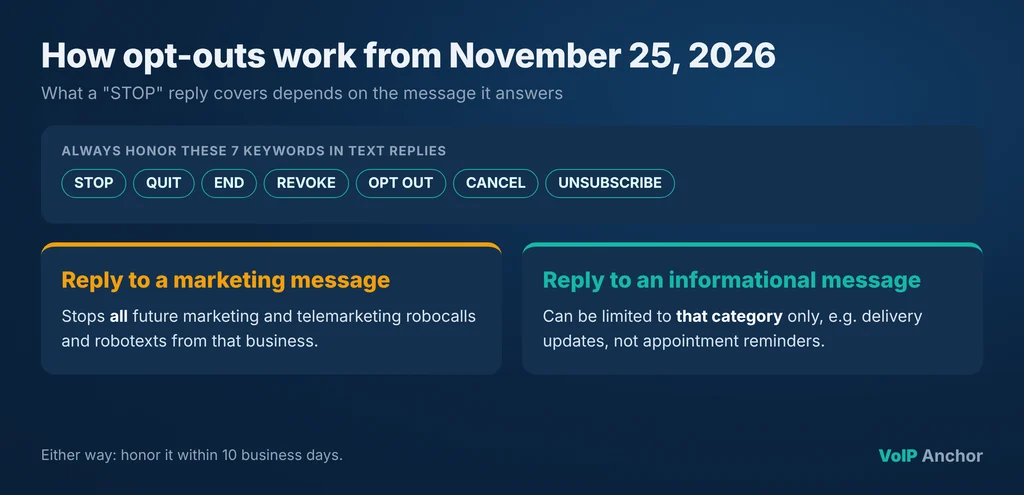
- An opt-out in reply to an informational message can now be limited to that type of message. An opt-out from marketing still stops all marketing.
- Businesses can choose an exclusive opt-out method, such as a reply keyword or a keypress during a call, if they disclose it clearly.
- Seven text keywords must always be honored: STOP, QUIT, END, REVOKE, OPT OUT, CANCEL and UNSUBSCRIBE.
- The 10-business-day deadline to honor an opt-out is not new and has not changed, though the FCC is asking whether to shorten it.
What did the FCC decide?
On September 30, 2026, the FCC voted 3-0 to adopt a Report and Order revising its consent revocation rules. The rules apply to robocalls and robotexts that need the recipient’s consent, which covers most automated and prerecorded calls and most texts sent from business messaging platforms.
The new order replaces parts of a 2024 FCC order that would have forced a much stricter “revoke all” approach. Under that version, a customer who replied STOP to a single delivery update would have had to be removed from every type of automated message from that business, including appointment reminders and fraud alerts. Industry groups argued this would cut customers off from messages they actually wanted. The FCC delayed that part twice, most recently to January 31, 2027, and has now replaced it with a more targeted approach.
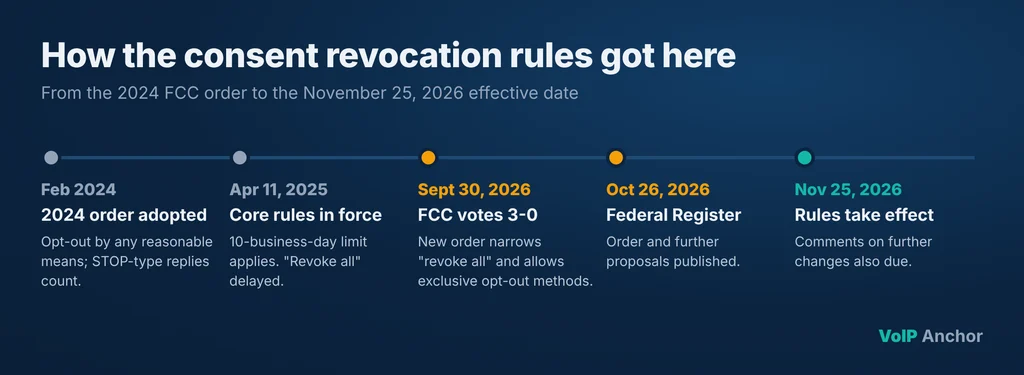
How we got here: a short timeline
- February 2024: The FCC adopts its first revocation order. Consumers can opt out by any reasonable means, and replying with words like STOP counts automatically.
- April 11, 2025: Most of the 2024 rules take effect, including the 10-business-day deadline. The “revoke all” part is delayed to April 2026.
- 2025 to 2026: “Revoke all” is delayed again, to January 31, 2027, while the FCC reconsiders it.
- September 30, 2026: The FCC adopts the new order and a further notice proposing more changes.
- October 26, 2026: Both are published in the Federal Register.
- November 25, 2026: The new rules take effect. Comments on the further proposals are due the same day.
5 changes that take effect on November 25, 2026
1. Opt-outs from informational messages can stay in their category
If a customer opts out after an informational call or text, such as a delivery update or an appointment reminder, you can treat that opt-out as covering only that category of informational messages. A customer who stops delivery updates can still receive, for example, appointment reminders they agreed to.
Marketing is different. An opt-out in reply to a marketing or telemarketing message still stops all future marketing robocalls and robotexts from that business.
2. You can choose an exclusive way for customers to opt out
Under the 2024 rules, customers could revoke consent by “any reasonable means”, which left businesses guessing about emails, voicemails and free-text replies. From November 25, you can designate one or more FCC-approved methods as the exclusive way to opt out:
| Approved method | How it works | Good fit for |
| Automated opt-out during a call | The caller presses a key or says a word to opt out | Prerecorded calls, IVR and dialer campaigns |
| Reply text with a standard keyword | The recipient replies with a keyword such as STOP | Two-way business texting |
| Designated website or phone number | The recipient opts out through a page or number you name | One-way texts and outbound calls |
The catch is disclosure. The method must be clearly and conspicuously disclosed in every call or text that needs consent. A line buried in your terms and conditions is not enough. If you don’t designate an exclusive method, the old rule keeps applying and you must honor opt-outs made by any reasonable means.
For calls, a keypress opt-out is easy to add to an IVR system or to the prerecorded message your dialer plays.
3. Text opt-outs: disclose one keyword, honor all seven
If you use reply texts as your opt-out method, you can disclose just one keyword, for example “Reply STOP to opt out”. But your system must still honor all seven standard keywords:
- STOP
- QUIT
- END
- REVOKE
- OPT OUT
- CANCEL
- UNSUBSCRIBE
Most messaging platforms handle STOP automatically, but check that every one of these words, including the two-word “OPT OUT”, is caught by your keyword rules.
4. One-way texts must say replies aren’t monitored
If you send texts from a number that can’t receive replies, each text must say that replies aren’t available and give a reasonable alternative way to opt out, such as a link or a phone number. This is common with short alerts and some toll-free or platform numbers, so check every campaign, not just your main one.
5. Banks get more room for fraud alerts
Financial institutions can send exempt fraud and data-security alerts to mobile numbers from “reliable sources”, not only numbers the customer gave directly. Examples include a number provided by an authorized spouse or family member on the account, a number captured when the customer calls the bank, and numbers in records from another financial institution. The other conditions of the exemption, including message limits and opt-out requirements, still apply.
What stays the same
Several rules many people assume are new have been in place since 2024 or 2025:
| Rule | Status after November 25 |
| Honor opt-outs within 10 business days at most | Unchanged (in force since April 11, 2025) |
| STOP-type keyword replies count as a valid opt-out | Unchanged, now fixed as seven keywords |
| One confirmation text, sent within five minutes, with no marketing | Unchanged (allowed since 2024) |
| Marketing opt-outs cover all marketing from that business | Unchanged |
| Do-not-call requests can extend to affiliates customers would expect | Unchanged; the FCC reminded telemarketers of this |
Ten business days is an outer limit, not a target. If your system can process opt-outs instantly, it should.
What the FCC might change next
Alongside the order, the FCC published a further notice asking for comments on more changes. None of these are rules yet, but they show where things may be heading:
- A shorter deadline: cutting the 10-business-day limit, possibly to seven business days.
- Two-way texting: ending one-way texting, or requiring two-way texting for marketing messages.
- A “revoke all” option: making category-specific opt-outs depend on offering customers a one-step way to stop everything.
- Affiliates: clarifying when separately branded companies count as one caller.
- Other tweaks: fewer standard keywords, and letting businesses ask which type of message a customer meant to stop.
Comments are due on November 25, 2026, and reply comments on December 28, 2026, according to a summary from the CommLaw Group. If two-way texting becomes mandatory, it would affect anyone sending alerts from send-only numbers.
Checklist for SMS senders and callers before November 25
- List every campaign. Include marketing texts, reminders, alerts, prerecorded calls and dialer campaigns, and the number each one sends from.
- Label each campaign as marketing or informational, and group informational messages into clear categories, such as delivery updates, appointment reminders or billing notices.
- Decide whether to use an exclusive opt-out method for each channel, and which one.
- Update every template and script. Add a clear opt-out line to each text, IVR prompt and prerecorded message, for example “Reply STOP to opt out” or “Press 9 to stop these calls”.
- Test all seven keywords on every sending number, including “OPT OUT” with a space and in lower case.
- Fix one-way numbers. Add a “replies are not monitored” line and an alternative opt-out link or number, or switch to two-way texting.
- Sync opt-outs across systems so a STOP in your texting tool also reaches your CRM, dialer and email platform where it should.
- Keep records of your disclosures, the date each opt-out was received and the date it was processed.
- Check your 10DLC campaign details. If you change opt-out wording or message types, make sure your A2P 10DLC registration still matches what you send.
- Brief your team. Agents and anyone using a power or predictive dialer should know how to log a verbal opt-out on the spot.
Who is affected?
- Businesses sending marketing texts, such as retailers, restaurants and ecommerce brands.
- Service businesses sending reminders, such as clinics, salons, repair services and schools.
- Sales teams and call centres running prerecorded or automated outbound calls.
- Banks, lenders and credit unions sending fraud alerts and account notices.
- Debt collectors and utilities that use automated calls and texts for account updates.
- Software and messaging platforms whose customers rely on them to process opt-outs correctly.
Getting opt-outs right also helps deliverability. Carriers and spam filters watch complaint rates, and numbers that keep texting people who said stop are more likely to be filtered or labelled. It’s the same logic behind STIR/SHAKEN caller ID checks on the voice side.
Frequently asked questions
When does the FCC consent revocation rule take effect?
The new rules take effect on November 25, 2026, 30 days after they were published in the Federal Register on October 26, 2026.
What opt-out words must businesses honor?
Seven: STOP, QUIT, END, REVOKE, OPT OUT, CANCEL and UNSUBSCRIBE. You can disclose just one of them in your texts, but you must honor all seven.
Is the 10-business-day deadline new?
No. It has applied since April 11, 2025. The FCC is asking whether to shorten it, but for now the limit stays at 10 business days.
Does a STOP reply stop every message from my business?
Not always. A STOP in reply to a marketing message stops all marketing. A STOP in reply to an informational message can be limited to that category of informational messages.
What happened to the “revoke all” rule?
The broad version from 2024 never took effect. The new order replaces it with category-specific opt-outs for informational messages, while marketing opt-outs still cover all marketing.
Do I have to choose an exclusive opt-out method?
No, it’s optional. If you don’t choose one, you must keep honoring opt-outs made by any reasonable means, such as an email or a free-text reply.
Final thoughts
The FCC consent revocation rule is one of the rare compliance changes that gives businesses more control, not less. You can keep sending wanted informational messages after a customer stops a different category, and you can steer opt-outs to a method you can track.
But those benefits depend on clear disclosures and systems that catch every opt-out. With November 25 only weeks away, now is the time to audit your templates, test your keywords and make sure every STOP reaches every system that needs it.
This article is for general information and is not legal advice. Check with a qualified TCPA attorney about your specific campaigns.